Thursday, 22 January 2026

Bigger beans- arriving in Italy and beyond

Photo by DQ Fuller, UCL Archaeobotany
 An important contribution to evolutionary history, and breeding, of broad beans (Vicia faba) appeared in Vegetaion History and Archaeobotany recently, namely work by the Lecce archaeobotany laboratory on beans from southern Italy, by Grasso, Arthur and Fiorentino (2025). This study documents the appearance of two step changes in broad bean sizes in the Medieval period, backed up by measurement data on a small set of comparative land races, but only from Italy. This paper seems to miss the opportunity to think more broadly about the timing and processes of the evolutionism of gigantism in Vicia faba, which is just one of a group of pulses that evolved larger-seeded varieties in circum-Mediterranean agriculture- a pattern that Vavilov drew attention to under the heading "Regularities of type-forming processes" (Vavilov 1926). This provides an opprotunity to ponder what processes drove evolution of, and cultural preferences for, macro-seeded forms of pulses in this region but not in others, and it relates to the broader issue of the mechanisms that drive regional varietal evolution in crops, which can indicate remarkable parallel evolution across different crops in the same region.

While broad beans (Vicia faba) are among the Neolithic domesticates of the Near East, and part of the the Neolithic dispersal in Mediterranean Europe, the beans one is likely to be familiar with today-- at least in traditional agriculture in Europe, North Africa or Turkey, are generally quite different and much larger than those of prehistory. To be sure beans would have increased over the size of their wild progenitor (although the wild progenitor appears now to be extinct: see Kosterin 2015, Caracuta et al. 2016), but they were modest-sized cultivars, classed as variety minor. In Britain we typically refer to these as "Celtic breans", appearing in the Middle Bronze Age and becoming moderately common in southern England in Late Bronze Age and Iron Age times (as per the useful review of Treasure and Church 2017). In England such archaeological finds, charred, are consistenlty less than 8mm long, putting their uncharred dimeniosn likely under 1cm (assume -20% for charring). Although poorly undertsood some small-seed faba beans are also grown in part of the Indian Himalaya, referred to in the past as subsp. paucijuga, but with no real archaeobotanical indications yet of when they got there.

Larger beans in historical Italy

Somewhat larger beans in Southern Italy and Naples, that can be classed as variety equina, the "horsebean", appear as a minoriy of finds only in the late 7th century AD at the site of Colmitella (Grasso et al 2025). Such seeds have lengths consistely >1cm and typically near 1.5cm, and maximum widtth >1cm. After this equina types become more widespread in Southern Italy. By around this time equina type beans have also been reported from Panjakent in Uzbekistan, and although Grasso et al raises some questions about this, I would see this as also representing larger faba beans of the mid First MIllennium AD.

Even bigger beans, of variety major, with lengths around 2cm beginning to appear in Southern Italy in the 13th century. Grasso et al. argue that these steps of size increase may derive from breeding for larger beans, perhap in Southern Italy-- farmers selecting first for equina and then some centuries later for even larger major varieties. 

The overall conlusion of Grasso et al. is to emphasize the importance of archaeological seed measurments, as a tool to discern variation and evolution within crops over time, even long after domestication (when measurments are more commonly used and reported). This I fully concur with. However, I would raise some alternative hypotheses and unanswered questions about the drivers of seed size increase in Vicia faba, by noting that this is one among a group of peer species that have similar geographically restricted patterns of seed gigantism in the Mediterranean.

Mediterranean macrosperma pulses

As I already noted Vavilov drew attention to the occurrence of large seeded pulses in Mediterranean Europe and Turkey as a recurrent varietal feature.  This pattern is seen not just in Vicia faba, but also lentil (Lens culinaris), pea (Pisum sativum), chickpea (Cicer arietinum) and grasspea (Lathyrus sativus). The most stark contrast is between the small seed size and seed weight of varieties of these species found in India versus the larger sizes found in Spain and Italy. Smaller sizes also typically characterize these crops in Ethiopia, Afghanistan and Iran. Vavilov's data indicates that average seed dimeters of Italian lentils are two times those of India, with seed weights about 4 times greater. In chickpea, Indian types are typically ~30% shorter than those of Italy with as much of 70% less weight. Peas are about 50% lighter in India than Italy, and grasspeas too are also substantially smaller (Vavilov compares those from France, Ethiopia and India). Thus rather than seeing this as a product of targetted breeding of bigger beans by Medieval Italians, I think there is an issue of parallel evolution that demands explanation. The map at left/above from Muratova (1931), part of Vavilov's research team, shows that in the early 20th century large-seeded (major) faba beans are European and Mediterranean. Similarly the large seeded (macrosperma) varieties of lentil overlap this: the map of another part of Vavilov's team, Helena Barulina shows this (right/below). Grasspea, pea and chickpea similarly overlap. 


So what we have is a feature of geography and history that is influencing several crops in parallel. I would therefore suggest that instead of explaining this by intentional selective breeding we need to think about evolutionary factors, environmental and cultural, that might drive this. It would be nice to have comparable seed size data across all of these to look at species and see if the timing of stepped increases were similar. (In some of the cereals we do see linked regional patterns of change... but I'll leave that for another blog...see Dal Martello et al 2025). Perhaps, they might contend, in Italy (or elsewhere in the Mediterranean) breeders were targetting these pulses to select them bigger. (And if this is the case, is there a cultural factor to do with bean cooking methods than favours this?). But such a view has the implication that farmers in other parts of the world were somehow incapable of this, which I find this an unconvincing notion of European exceptionalism! 

Instead we might frame hypotheses about factors that favoured smaller seeds, for example in Afghanistan or India. Small seeds should require less water during the period of seed filling, and in crops such as this that mature in the months after winter that are hot and dry in places like India this could be adaptive. By contrast in the more gentle, showery spring around the Mediterranean water is not in such short supply. Smaller beans can be expected to cook faster too, so they might have lower wood fuel demands in areas where fuel is at a premium (across Iran and semi-arid India).  We can also think about other factors that promote larger seeds, such as increasing field disturbance and burial depth. It is only in the Mediterranean from late Roman times onwards that true ploughs, the mouldboard plouogh that turns over the soil, comes into use, whereas in India scratch ploughs (the ard) persist (even to today). I have previously speculated (Fuller 2007) that technological differences such as this might favour size increases under the deeper ploughing regimes. On top of this some farmer choice may well have operated too as an additional amplifier-- after all seed size multi-genic trait. 

I would note that there is another set of pulses and geographical context where gigantism can be noted, in East Asia. Here soybeans and adzuki beans also have macro-seed varieties much larger than the early domesticates that are well-documented in Neolithic or Bronze Age times. It also a part of the world were true ploughs that turn the soil come into use by the early centuries AD (Han Dynasty), spreading thereafter. Is this another context in which advances in tillage technology, perhaps coupled with irrigation and reduction of water stress, set in place conditions of seed gigantism to evolve in legumes. This seems to me to call for thinking about common causal drivers of unconscious selection that cut across cultures and crop species. Clearly more time series of archaeobotanical measurements are needed to make such comparative studies feasible.

Bibliography

Barulina, Helena (1930) Lentils of the U.S.S.R. and of other Countries. Bulletin of Applied Botany, of Genetics and Plant-Breeding 40. Leningrad [in Russian, with English summary]

Grasso, A. M., Arthur, P., & Fiorentino, G. (2025). Morphometrics shed new light on the first archaeobotanical evidence for the cultivation and breeding of Vicia faba var. equina (horse bean) and var. major (broad bean) in medieval southern Italy. Vegetation History and Archaeobotany, 34(6), 813-823.

Muratova, V. S. (1931) Common Beans (Vicia faba L.). Bulletin of Applied Botany, of Genetics and Plant-Breeding 50. Leningrad [in Russian, with English summary]

Vavilov, N. I. (1926) Centres of origin of cultivated plants. Bulletin of Applied Botany, of Genetics and Plant-Breeding  16(2) [Russian original], English Translation by Doris Love in Vaviliv (1992) Origin and Geography of Cultivated Plants. Cambridge University Press.

Wednesday, 21 January 2026

Archaeobotany lab at UCL refurbished and reopened

UCL Archaeobotany Laboratory
This past summer the UCL Archaeobotany Laboratory was refurbished and enlarged (slightly), thanks to funds from the A3RC project funded by the UKRI Research Infrastructure forConservation and Heritage Science program. Over the past term we have moved collections and equipment back into the lab. This offers some improvements for teaching practical courses in the lab, such as my seed identification short course, also a MSc course (email me to get on the waiting list for future), and facilities for visiitng researchers who come to consult the collections for identifications. Over many years Dr. Sue Colledge has been cataloguing the extensive references (more 19,000 accession catalogued), a catalogue which we aim to make available online soon. Dr Ayelen Delgado, the new technician for archaeobotanical collections is working on a new catalogue legacy collections of archaeological plant remians. As part of our lab re-launch we have a new instagram account to feature modern and archaeological specimens, @archaeobotanylab, which will also report news coming out of the lab.

For my part is is high time I reactivated this blog with surveys of important finds from the world archaeobotany and critical reviews of publications, as I was know  for a decade ago. Its time for me to provide some updates on some of my favorite topics, like rice, millets, domestication and archaeobotany in Africa, the Near East, India and China (among other places).


The archaeobotany laboratory here at the UCLInstitute of Archaeology has a been centre for research and teaching for over 60 years. Geoffrey W. Dimbleby (1917-2000) was appointed as Professor of Human Environment from 1964 (to 1979) [obit. by Harris], succeeding the famous archaeozoologist and geoarchaeologist Frederick Zeuner. (Zeuner's successors in zooarchaeology are still going strong here at the Institute too). After Dimbleby's retirement (1979) David R. Harris became Professor Human Environment (1980-1998), moving from UCL Geography. David was a great synthesist and theorist of domestication and agricultural origins. To enhance the more practical aspects of archaeobotanical research and teaching Harris recruited Gordon Hillman in 1981, who brought extensive plant collections from Turkey and Syria. Gordon Hillman tuaght and trained many archaeobotany students through 1980s and 1990s-- although the lab was then in a different and smaller room. Harris and Hillman retired in 1998, and I was lucky enough to be offered a lecturing position starting in 2000. We moved the lab into its current space in 2000/01, the first academic year in which I attempted to teach practical archaeobotany at the Master's level. (I like to think my teaching and experience has come along way in the quarter century since then.)

Sunday, 6 February 2022

The drug before the calorie? Some hazy thinking on Cannabis domestication

Many have been excited this week about headlines claiming marijuana (Cannabis) was domestication in China 12,000 years (making it the first crop in East Asia). As the reputable journal Nature put it "pot farming first blossomed" in China 12,000 years ago. But was it so? How clear or otherwise in the evidence? Is it really farming? The study by Ren et al in Science Advances paper is important-- it represents the largest collection of Cannabis genomes sequences, it provides some important information on subpopulations and genes that have been selected for differently in fibre hemp from drug strains. However, I finds is dicussion and conclusions riddles with both imprecision (about chronology, geography and cultures) and inaccuracies. So what should be questioned?.


A major source of inaccuracy lurks in sampling and geographical representation. This is compounded by the fact that in many countries growing or collection or transporting of Cannabis is illegal (although legalization is on the rise). Thus traditional drug varieties have not been sampled across most of Central Asian countries, Afghanistan, Russia, Iran. It should go without saying that sampling in the modern time plane will miss past diversity that has been lost to ha bitat destruction and environmental change; such a problem, for example, has plagued some genetic studies of rice-- as wild population no longer exist in the regions were it was first cultivated (such that a modern genome map is not a map of origins). But even so the limited sampling across free-growing (feral/ wild) outside of South Asia and China) is notable. Compare the map of Ren et al (above) with that from the Cannabis book by Clarke and Merlin (2013), which highlight how much more wild/feral diversity there is out there across Asia and eastern most Europe, including 'wild' populations south of ot eh Caspian sea in Iran and along the Volga River in Russia. Even the map from Clarke and Merlin is incomplete with regards to Afghanistan where Vavilov collected apparently wild drug types of Cannabis (C. indiva var. afghanica) in the 1920s.

Given how few wild/feral samples that they have can they really rule out multiple domestications. Genetic analyses often err on the side of single origins. Simulation work (Allaby et al 2008 PNAS) have shown that this will be true even for crops with multiple origins, because gene flow among crops of different origins and pruning of lost branches (not sampled or not surviving to present). Their analytical methods are more modern and more sophisticated but I am not sure they can rule out multiple origins, and they certainly can’t rule out origins from regions not sampled or where wild populations are extirpated (e.g. Japan). Also wild populations (lets assume there are some in central Asia) can be heavily inundated with gene flow from crops over time make their original dinstictiveness hard to find in modern genomes.

A major issue is imprecision in dating. Genomic dervied estimates will never rival radiocarbon dating on archaeobotanical remains. Their proposed date of origins (is this domeatication?) has 6000 year error margins. And it not clear what they date! Was a divergence  between two wild population separated due to climatic vicariance at the end of the Pleistiocene or start of the Holocene, or is it meant to be the domestication bottleneck? The equivalent genomic dates for Asian rice domestication are ca. 18,000 BP and something close to 10,000 for African rice. Both of which are way off. African rice is domestication at more like 3000 BP and Asian rice at more like 8000 BP (of course it matters whether one is talking about the beginning or end of a process, as domestication takes 3000-4000 years in terms of morphological evolution/ genetic fixation.

By contrast archaeological dates are much more precise, at worst with 100-200 year error margins, but Ren at all quote these very imprecisely. It is as if they wish archaeology was less precise, but even then it would not approach the dating imprecission attached the the genomic dates. The say "~3000 BP" for the appearance of Cannabis in India, but if we are rounding off it is closer to 4000, as it occurs in the Late Harappan horizen (3900-3500 BC). Although Indian epics are not well dated some parts of them are from oral traditions that probably also date around then and make reference to Cannabis- I think Ren et al refer to this as ~2000 BP. Cannabis comes to India in my view as part of “Chinese horizon”, which is really just piece meal adoption of various things coming in via central Asia including crops and technologoies (harvest knives) from China, peaches, apricots, millets, japoonica rice. For discussions of this see, for example Fuller & Boivin (2009); Stevens et al (2016). Whether or not it arrived in South Asia earlier, or was already utilized from wild populations in the Himalayas, does not really make much differece to the whether or not cultivation began at the start of the Holocene in China. The imprecision in genetic dating, however, makes it about as likely that domestication took place around the start of the Yangshao period (~5000 BC), the period when we generally see the ending of the millennia long domestication process for the native China millets (

They are also quite imprecise about geography: are they suggesting a NW China (Xinjiang) or NE (Chifeng) source? And if either of these then discussion of early cord-marked pottery in South China (mostly south the Yangtze) is really not relevant, and yet they discuss this as though it indicates the use of hemp cords-- for which there is simply no evidence. 

Cannabis is undoubtedly an important crop brought into cultivation early in east Asia, esepcially for its medicinal and/or social uses, but becoming important for larger oily seeds and fibres over time. But in my view its development as a crop either parallels or is even inspired by the increasing importance of cultivation of other taxa, like the China millets. And this process could easily have played out multiple times-- perhaps in very different contexts in parts of central Asia or Jomon Japan, even amongst non-farming cultures. While genomic data will contribute to this, modelling such data really requires some calibration points in time and space, which will ultimately come from archaeobotany.

Sunday, 28 June 2020

Chicken origins: closing in with new genomic evidence

wild Gallus gallus spadiceus
The past week saw the publication of a landmark genomic study on chickens (Wang et al 2020, Cell Research), which clarifies much about origins, and focuses some questions for further research. For a news summary see Lawler's Science piece.

It is transformative because it includes a substantial sample of genomes from across all of the wild subspecies of Red Jungle Fowl (142 wild red jungle fowls) and other wild Gallus species. The first thing to note is that is does support the reality of these different wild taxa. They aren’t merely geographical feral populations derived from escaped chickens, but they are differentiated from each other, making it reasonable to ask which population(s) are ancestral to domesticated chickens. In addition there has, of course, been gene flow via introgressions with domesticated chickens, but this has been on a more limited scale. So the answer to big question (of origins) appears to be Gallus gallus spadiceus. G. g. spadiceus is geographically focused on Burma, Yunnan, Guangxi, northern Thailand and bits of Laos. This struck me as the most surprising—this geographical derivation. If one favours a Chinese origins then you would look to G. g. jaboulliei (of the Guangdong and Fujian and perhaps further north in the past); if one favours an Indus domestication then one looks to G. g. murghii. Previously I have accepted the likelihood of an Indus Chicken domestication and a spread through India in post-Harappan times (e.g. Fuller 2006). This now appears unlikely. Instead it probably means that wild jungle fowls attracted attention in the Harappan period as pretty birds that were captured sometimes, traded, etc.,but not really domesticated subsistence species. Presumably the first Bronze Age Mesopotamian and Ramesside Egyptian “chickens” were actually pet wild jungle fowl-- fancy exotic birds-- and not connected to chickens as we understand them now. The "multi-colored birds of Meluhha" that were imported to Mesopotamia at the end of the Third Millennium BC from the Indus region, are plausible painted ivory statuettes of murghii jungle fowl (see, e.g. During-Caspers 1990).

These new genetic data also make it clear that as chickens spread out of their northern SE Asian homeland they did pickup some genetic material through introgression with local wild jungle fowl (such as G. g. murghii in northern India) and even grey jungle fowl in South India (the source of yellow legs: G. sonneratii). This process can be called “introgressive capture” and it is widespread in most livestock and many crops. This process has sometimes confused genetic studies into inferring multiple domestications, but with more genomic data it can now be disentangled (see Larson and Fuller 2014). 

It is also quite exciting that they have some genetic loci that might be under positive selection as part of the domestication process. One of the real mysteries with animal domestication is what constitutes domestication in a genetic sense in terms of adaptations. In plant it is well known that certain genes for seed dispersal, growth habit, dormancy, grain size, etc. were selected. We can find this evidence genetically and tie it to morphological changes in the archaeobotanical record. There is so far nothing equivalent in animals that links genetic loci to the morphological adaptations we see with animal domestication. So on a more theoretical level this may be the first step to actually starting to unravel the genetics of animal domestication.

These raises fascinating questions then about the contexts in which G. g spadiceus was domesticated—what kinds of human societies and agricultural economies did it interact with in its wild form and how did it get incorporated into ecology of human settlements. Equally at what period and in what contexts did these early chickens then spread. Their phylogenetic results suggest the first wave of chickens spread through SE Asia and SW China only.  Sadly we know little about the Neolithic in Myanmar, or Guangxi or Southern Yunnan; we do have some data from northern Yunnan where Chinese millet and rice agriculture (with pigs) arrives from the North around 2600 BC. One presumes there was some further Southern diffusion towards the China/Burma borderlands. And perhaps it was in these borderland zones where early sedentary rice/millet farmers began to isolate some G. g. spadiceus populations that came feed within the human settlement niche. As hypothesized in Larson and Fuller (2014), chickens likely followed a commensal pathway to domestication. But we now need to refine the map (right). And work out when this happened.


There estimate of the age of the last common ancestor of domesticated chickens and G. g. spadiceus 9500 BP (+/- 3000). But I would regard domestication any time between 10000 BC and 4500 BC as highly unlikely. As the authors themselves not in the first paragraph of their discussion such genetic estimates of domestication age tend to be over estimates (by upto 15,000 years!), so these are not exactly reliable.  In fact I would regard the tendency genetic coallesence ages as to tell us anyting about the timing of domestication to be a highly  misleading tradition that is entrenched in genetics but has little to back it up. Take the example of rice (Oryza sativa), where the genetic estimate of last common ancestor of cultivated rice and modern wild population is ca. 18,000 (Choi et al 2017). But archaeologically even the more generous estimates are ~10,000 (and more like 7,000-6500 by more cautious approaches). I suspect a more general problem is that what is being picked up the last major cladogenetic event that structured wild populations and not domestication itself. Often this can be expected to be something climatic, so 9500 BP is telling us something about how Early Holocene climatic changes—which restructured vegetation in big ways—restructured wild jungle fowl. Then it was one of these localized population that millennia later got domesticated. In all likelihood that localized population that was actually domesticated won’t exist anymore. It is also worth noting that the reality of domestication bottlenecks is itself somewhat dubious and is in the past year or two come to be questioned. Where ancient DNA is available (e.g. maize, sorghum, barley) it is demonstrable that no such bottleneck occurred and age estimates (see Allaby, Ware and Kistler 2019) that conceive some sort of a bottleneck may not be really telling up about domestication. 

Given what we know of the archaeology of SE Asia, one would tend think the initial  domestication and spread of chicken is unlikely earlier than the grain-based Neolithic that starts around 2500 BC (in southern bits of China) and reaches southern Thailand at 2000 BC. However, as far as I know there are no archaeological chicken finds at early sites. So I wonder whether the first spread of domesticated chicken might represent a secondary later spread perhaps closer to 1000 BC (the period when Bronze working spread southwards from China); this might also be the period when new crops spread like sticky rice. It may be that at that time chickens also spread rapidly via trade routes to India. I have long argued (e.g. Fuller 2007) that in South India the Dravidian linguistics suggest arrival of chickens after the South, South-Central and Central languages had fully diverged (which is something like 3000 years ago). Not long after this there are good chicken terminologies in Sanskrits and Prakrits from the 1st Millennium BC, so it makes sense that chickens really only became established as livestock in India at around that time, and of course it is the later Iron Age when they first turn up in the west , such as the Hellenistic era evidence from the Levant (Perry-Gal et al 2015), or as an exotic animal in western Europe (Sykes 2012).

Rice awn reduction: not a domestication trait


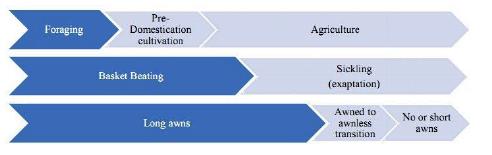
In a recent paper in Economic Botany, Svizzero, Ray and Chakraborty (2019) ask whether awn reduction is really part of the domestication syndrome of rice or instead a crop improvement trait. It is true that I once listed this as part of the domestication syndrome traits in cereals (Fuller 2007): awn/appendage reduction, but I don't think I really pressed for this to a be central part of domestication. It was only meant to identify a tendency that recurs across most cereals. I would now agree that this post-domestication and varietal improvement trait. That this should be regarded as post-domestication/improvement trait is clear from the fact that it affects only some lineages of rice (most temperate japonica, many indica, but few tropical japonica or circum-aus, and mostly not Oryza glaberrima). Many cultivars have awns of varying length. The authors usefully illustrate diagrammatically how economy (foraging, pre-domestication cultivation, agriculture), harvesting methods and the evolution of some morphological traits (like the awn) are not synchronous changes. These are part of what makes domestication a protracted and entangled process.

In the case of rice, the presence of awns may have actually been necessary during the early stages of cultivation! This is the implication of recent work by the Kobe rice genetics group (Ishii, Ishikawa and colleagues), who have recently published data identify three interacting loci in rice (Amarasinghe et al 2020 in Rice) . They have worked the slow processingf of backcrossing indica genetic components into a population of wild rice, and are able to document the additive effects of 3 loci on reducing the awn length. The reason that awns are important in wild rice has to do with seed dispersal-- like in other cereals awns help to propel spikelets across and into the soil, and in the case of rice they likely also play a role in dispersal across water. But the reason they would have been important to early rice gatherers and the first rice cultivators is that awns mean that grains, even after they have shattered, to get stuck within the rice panicle, making them more readily gatherable by people. This goes hand in hand with a key domestication trait, previously identified by work at Kobe, namely the closed panicle morphology (controlled by the OsLG1 mutation, also called SPR3, published in Nature 2013). This closed panicle trait would make the more compact panicles easier to harvest, especially with long awns that allow shattered spikelets to get caught. Indeed, the data in Ishii et al (2013), allows us to estimate an increased in return rate on harvested rice, with just this mutation of about +50%. This actually implies that awns were selected for during earliest phases of cultivation, but would have lost selection advantages (in terms of harvest) once non-shattering became dominant.  Thus, as concluded by Amarasinghe et al 2020 after domestication it became reasonable to selected for reduced awns. Without awns harvested spikelets take or less space and plant would not have needed the same degree of metabolic investment in producing awns. The reduction of awns is also common in many varieties of wheats, barley, oat, but I suspect it was not actually part of the initial domestication in these either. Thus the conclusion of Svizzero et al (2019) may well have relevance to many cereals beyond rice.

However, Swizzero et al are wrong that this trait can not be studied archaeologically, even if it really hasn;t been so far.  We are able nor to recover lemma apex remains and determine these as awned or awnless (as in the example at left from work by Cristina Castillo at Khao Sam Kaeo, Thailand). In recent years work by Castillo, myself, and others has increasingly recovered these from flotation samples. They are lightly smaller than spikelet bases, less common than spikelet bases but nevertheless can be reognized as either complete apices (with a beak like end) or torn (like the one at left) indicating that they were awned. Thus there is potential to study this archaeologically. The example shown here is part of a dataset that indicates the predominance of awned japonica rice in Thailand upto at least the Iron Age. In waterlogged material from the Lower Yangtze it is clear that early rice, even non-shattering ones are awned. More work to be done on recognizing when and where awnless rices became common. Reduced awn or awnless rices appear to be present at Roman era sites on the Red Sea soast of Egypt (at Berenike and Quseir al-Qadim), at which time they are presumably being imported from somewhere in southern or western India (published in the books by Rene Cappers, and Marijke van der Veen).

Rice domestication was slow, and post-domestication varietal diversification, including the reduction of awns in some varieties, took even longer. And there is much we still don't know about this history-- but a history of varietal and geographical diversification starting to be unravelled in part through genomic history (but that should be a post for another time).

Sunday, 21 June 2020

Citrus diversity in Roman Naples: pollen evidence for tangerines

Lemon, Citron, Chicken
The early history of Citrus fruits in the Mediterranean has been an active area of discussion amongst archaeobotanists, historians and palynologists in recent years. It has been well-established that citrons (Citrus medica) and lemons (Citrus limon) were known. For one thing they appear distinctively in Roman art, and for another their seeds are well known from Pompeii (e.g. Celant and Fiorentino 2018). What has been less clear is whether anything that we would call an orange today was known. Despite plausible textual sources, it is always hard to translate ancient terms into botanical species, especially in Citrus fruits that are so variety-rich, prone to both hybridization and frequent somatic mutations. So I have tended to think that some of the few orange-like seeds from Pompeii and from Rome, might just be outliers in the range of variation of early lemons (which are likely to have some pomelo and orange related ancestry in their South Asian origins (see, e.g. Fuller et al 2018). But an important new morphometric investigation of pollen of several Citrus species and archaeological pollen from Oplontis (near Pompeii) seems to have cleared this up. 


Lumaga et al. (2020) in a recent Vegetation History and Archaeobotany article, demonstrate the clear distinction in exine form, especially the cell or lumen size, that differentiates oranges (C. reticulata- the more primitive species, or less hybridized, of mandarin oranges or tangerines and similar small, sweet fruits). Much larger lumens characterize lemons. So I stand corrected on the Citrus diversity of Roman Italy: at least citrons, lemons and mandarins were grown.

This raises interesting questions about how these got to Rome. While these oranges were certainly known in China prior to the Han Dynasty, I have previously deduced that early orange in India-- known from Prakrit and Pali sources of the First Millennium BC-- naranga-- were perhaps most likely bitter oranges (Citrus aurantium), with sweet fruits coming later. Long distance transport of fruits from China to Rome strikes me as unlikely, so perhaps then there was more fruit diversity in northern Indian after all included under the rubrice of naranga, or other less obvious terms. Early South Dravidian languages (precursor to Old Tamil and Kannada) do seem to have two different kinds of oranges. This highlights all the more need for archaeobotanical investigations of early citrus (hidden in flots as charred rind fragments) throughout South Asia and Middle East in the Iron Age period.

I was recently interviewed about the history of Citrus fruits, especially oranges, in Europe in relation to how we can understand their use and symbolism in the writings of William Shakespeare: find the podcast here: That Shakespeare Life.


Saturday, 20 June 2020

On the Anti-Neolithic of Cyprus

Cyprus is the first place that we know that crops and livestock were spread to by human action. This even took place before domestication. Morphologically wild wheat and barley, cattle, sheep and goat that appear wild. Cats that were presumably following mice that were stow-aways with grain stores on those early boats; early meaning ~9000 BC. But despite this very early start on the path to agriculture, Cyprus throughout the Neolithic and into the Bronze Age appears decidely unagricultural, what I might dub an anti-Neolithic. This is evident due to the accumulation of archaeobotanical and zooarchaeological evidence, that my colleague Leilani Lucas has been compiling and analyzing for several years, and which is summarized and discussed in our new Journal of World Prehistory article.

Long-term Cypriot trends  in cereals (vs. wild plants)
 Cyprus (black squares) vs. the
mainland (above). Below: proportion of deer
out of  consumed meat (below) 
Cyprus is perhaps quintessentially an island, in the sense of demonstrating evolutionary patterns that work differently from the large land areas and populations of the mainland. So years ago her work demonstrated that in terms of morphological change, domestication processes seem to be happening faster on Cyprus, with much higher rates of grain size increase in wheat. But this does not mean that wheat became quickly important or even that the overall economy was especially agricultural. Instead it appears that cereals (and other crops) remain a minor, rather than dominant, part of the economy for millennia (see left). This is in contrast to the mainland Fertile Crescent where increasingly morphological features of domestication are accompanied by a trend towards increasing use of cereals and dominance of wheats and barley out of all plant remains. If agriculture as an economic change is properly decoupled from domestication (and genetic change), then these trends clearly do not go together on Cyprus. The same is clear in the faunal record. Despite the early translocation of mammals, including livestock or potential livestock (like cattle) but also wild game (like boars and deer), it is hunted game, especially deer, that dominate bone assemblages. Cattle even plausibly go extinct and get reintroduced to Cyprus. For fully agricultural economic systems one perhaps needs to look at transformations from the Middle to Late Bronze Age, driven by Cyprus getting more central to a world system of trade, in which cultivation of "cash crop" fruits became important. In this context continued hunter-gatherer economic activities  lost ground to the food and economic production activities that transformed the wild fringes to investment agriculture.

Thus despite material culture that we class as Neolithic (and Bronze Age) the economy looks rather anti-Neolithic.