Showing posts with label starch. Show all posts

Thursday, 8 March 2012

Does starch evidence push back foxtail millet domestication?

A recent article in PNAS, by Yang Xiaoyan et al., on starch grains (and some phytoliths) from two early Holocene sites in northern China (approx. 9500-7500 BC), pushes back evidence for the early cultivation of foxtail millet. This builds on recently reported identification criteria for millet starch.  This paper is an important contribution to the earlier prehistory of grass and millet exploitation in Northern China and provides important new evidence for the discussions and debates about the timing, areas and processes of millet exploitation and initial cultivation. For on thing it highlights the importance of grasses, including a large proportion of millet grasses, in the subsistence of later hunter-gatherer, or cultivator transition, northern China. This hints at a contrast with nut-hungry and acquatic-focused south (Yangtze). These new data make foxtail millet exploitation, and possible cultivation, at least as early, if not earlier, than the claimed early Panicum from Cishan (although in the latter case, hard evidence for cultivation rather than gathering remained elusive). Phytolith data indicates the occurrence of Panicum miliaceum types only from late Donghulin. Taken with other recent finds this is suggestive that Panicum and Setaria were not brought into cultivation together, perhaps each more than once, and separately, in different parts on northern China. The bringing together of these two crops, fully domesticated, in an integrated system, would seem to be a key transition, yet to be identified, but which must have happened by the time of the emergence of the Early Yangshao tradition in the first half of the 5th Millennium BC.

The trends that Yang and colleagues have found, towards more of the larger Setaria italica like starches are suggestive a subsistence shift, and potentially as the authors argue, of changes evolving in foxtail millet, as part of the domestication process. More data from more sites and periods are needed, however, to confirm whether this a real trend. It would also be nice to see what these kinds of ratios look like on later sites with clear macro-remains of domesticated foxtail millet.

Nanzhuangtou and Donghulin as early Holocene/terminal Pleistocene transition sites with early pottery are often cited as the precursors of more typically Neolithic miller cultivators but have lacked much of any archaeobotanical evidence. These findings will take on an obvious significance to those interested in the early Holocene or early agriculture in Northern China. This study is also a good example of careful archaeological starch research, and is therefore wider methodological interest. Although starch grain research has become increasingly popular in China, some studies have been rather unconvincing, especially with regards to methodologies for identification and for being clear about uncertainties. That is not the case here, where a clear methodology for identification of millet-type starch grains has been employed which is in part qualitative and in part quantitative and it includes a clear recognition of some of the uncertainties in secure species level identifications, especially of smaller and less fissured starch grains. It is also clear that the reference collection of modern material that has been studied is the most extensive to date for Chinese grasses and this increases greatly the likelihood of their reported identifications. The inclusion of control samples of sediment and loess from Donghulin to check for contamination is also methodologically very important, since modern contamination will always be a concern in starch studies. It is also good to see consideration of the presence of immature starches, since immature millet grains are a significant component of charred assemblages, and significant present on immature/unfilled spikelets has been noted in Chinese agricultural texts throughout history, since records in the Han Dynasty. The recognition of carbonized immature Panicum grains has recently been bolstered by an experimental study blogged previously.

Monday, 5 March 2012

20,000 yr old huts from Jordan


This report on Kharaneh IV, published in PLoSone  a couple of weeks ago, has a lot of people excited: well-preserved hut features from the early epipalaeolithic of the southern Levant, over 20,000 years old, are a pretty uncommon archaeological find. Most sits of such age provide a bunch of chipped stone, some animal bones and if one is lucky some wood charcoal. Of course, this period has already produced the remarkable Ohalo 2 over in Israel, with amazing plant preservation in burnt down huts of similar age, partial details of which were published in J. Arch Science by Ehud Weiss et al in 2008. One of the problems of Ohalo 2 has been there is so little to compare it with, apart from sites of much later periods. Now there is the opportunity. No plant evidence from Karaneh IV has been reported yet, although colleague here in London are working on it, Sue Colledge on the flotation samples, and a PhD student Monica Nicolaides is working on phytoliths and starch samples. We can expect some important results id due course, although it is unlikely to come close to Ohalo in terms of quantity and preservation in macros, but supplemented by much more systematically collected micros. Other exciting work on the faunal remains is taking place down the hall here, by Lousie Martin, Liz Henton, and Anna Spyrou, which will provide insights into mobility and seasonality.

The archaeology of this site has received plenty of media attention on-line already, and a useful summary at about.com.

Wednesday, 8 February 2012

The rapid spread & differentiation of maize: new Peruvian data

New finds from the N. Peruvian coast report clear evidence for an earlier arrival of maize the region than previously thought (Grobman & al., PNAS), and with wonderful dessicated preservation indicating that they are popcorn varieties, but flourly varieties are also present. That there is a popcorn indicates quite rapid early varietal diversification, and these show already traits of South American rather Mesoamerican varieties. A direct AMS date puts these back to at least 4500 BC, so still a few millennia after perhaps 7000 BC date for the earliest maize in its Mesoamerican place of origin. The macro-remains are augmented by phytolith analyses and strach grains extracted both from the maize cobs and tools. Of methodological interest is the apparent discrepancy between dates on dessicated and dates on carbonized material, with the dessicated stuff being way to young. This may mean the dried stuff may sometime get contaminated with young carbon in some way (whereas the charred stuff has it true carbon fixed nicely by carbonization). Also of note is that maize is apparently not the most common plant find, and was not the dietary staple, although the present PNAS article focuses on the details of maize and we will have to await another forthcoming publication in Antiqiuty for more on the chillis, beans, squash and wild plants. Another discussion of this paper can be found in ScienceDaily news report from a couple of weeks ago.

Sunday, 5 February 2012

Millet starches: towards a systematic and quantitative approach

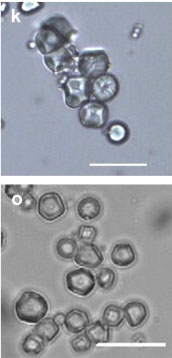
Yang Xiaoyan et al. have published their latest key to millet starch identification (for China) in J. of Archaeological Science "From the modern to the archaeological: starch grains frommillets and their wild relatives in China". This is an important development, partly because it is the largest comparative study yet from that part of the world (although arguably still not large enough in terms of taxa and populations!), but mainly because it provides some highly plausible and well-quantified guidelines on millet starch identification. It shows quite clearly that there is quite a lot of variation within a grain, a species and genus, the Paniceae, but also degrees of underlying similarity. The take home message is that every individual starch  is unlikely to be identifiable to the same level, to species or genus, but that some may be highly suggestive (the especially large and wrinkled examples are more common in Setaria italica than in wild Setaria or Panicum), and if on an assemblage level morphometric can be used to assess the probability of certain taxa. In other words it is the first step in building a probabilistic, rather than some qualitatively absolute, determination that the Chinese millets or there wild relative were present. Interestingly it indicates that Setaria italica is in principle far more recognizable than Panicum miliaceum, which has more 'generic' millet-grass starch. This means that rather than trying to take a small sample of few starch grains and pronounce a species presence that may not be believable, a more stasticial approach can be taken to determine a degree of likelihood. Such a quantitative apporach also open the possibility of tracking assemblages changes, which in turn might be connected to other lines of evidence for agriculture change or even plausibly put together in models about population change such as domestication processes, since Setaria viridis and Setaria italica differ in their starch grain assemblages. It also raises another potential area of investigation, which require further work, environmental conditions, since there does appear to latitude-related variation amongst  Setaria italica populations studies-- so further work is needed. The this is the best step in the right direction we have seen increasingly popular Chinese starch research world.

Thursday, 22 July 2010

Archaeobotanist honoured in Science

It is not everyday that archaeobotany received much 'mainstream' attention. But recently it did: Science on 2 July 2010 includes a profile of Dolores Piperno, one of our fields seniors figures in phytolith work and a pioneer in applying starch grains to the archaeology of the Neotropics.

Tuesday, 14 April 2009

New World Archaeobotany Watch: early dates for maize and other centres

Rio Balsas Maize, 6700 BC. New data pushes back maize earlier in Mexico than outside mexico and in the right part of Mexico, but notice that it is already domesticated, which means the beginnings of cultivation are earlier. This has a ScienceNOW post by Michael Balter, and the artilce by Piperno et al in PNAS (March 2009), "Starch grain and phytolith evidence for early ninth millennium B.P. maize from the Central Balsas River Valley, Mexico," needs to be read with the Ranere et al PNAS paper in the volume on the archaeological context., "The cultural and chronological context of early Holocene maize and squash domestication in the Central Balsas River Valley, Mexico".

North Peruvian Early Agriculture. Starch grain data from human teeth confirms the consumption og Phaseolus beans, squach (Cucurbita cf. moschata) and peanut at ca. 6000 BC, as reported in the recent (Dec 2008) PNAS paper by Piperno and Dillehay. The confirms the evidence of macrobotanical remains reported by Dillehay et al in 2007 in Science, in which AMS dates pushed cultivation in this region back to 7000-8000 BC. While all this may be suggestive of this area being an early focus of agriculture (and it featured as possible centre 3c in the recent Purugganan and Fuller map in a Nature review), some of this crops (certainly peanut) and arguably squash (?) were probably not native this particular region, implying that their start to cultivation was somewhere else and even earlier!

North American Early Crops. The latest installment on the evidence for indigenous domesticates of the later Mid-Holocene of Eastern North America is represented by the Smith and Yarnell report on the Riverton seed assemblage in PNAS 7 April 2009, which includes some of the classic 'lost crops' of North America such as Hordeum pusillium and Chenopodium berlanderi