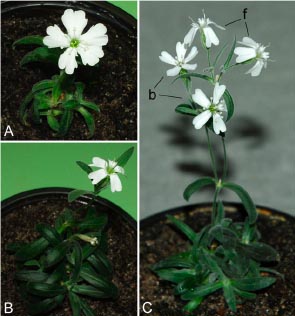
One of the most remarkable, and unusual, pieces of archaeobotany I have seen lately is the report of bringing back to life Pleistocene campion (Silene) flowers, published by Yashina et al in a recent PNAS. Ancient seeds did not themselves germinate, but their genetic material, from immature fruits, was cultured in vitro and then propagated clonally. So the images at right are clones of a plant that was trapped in frost some 31,800 years ago. It is not strictly archaeological, there is no report of a human site there. Direct AMS dates put fruits, apparently from ancient rodent (squirrel) burrows back to over 30,000 years old.
There are of course periodic reports of extremely old seeds germinating, although in most cases is unlikely that seeds of more than about a century or so, with germinate. See, for example, Barbara Youngman's old review on the germination of old seeds (in Kew Bulletin 1951). "Mummy wheats" are a myth. In general, longevity may decrease rapidly for many seeds after a decade or so. But natural ice mummy seeds, would appear to be a reality, or at least a source of genetic material that might be propagated by lab methods. As seed banks have learned freezing temperatures can keep seeds longer, slowing down all manner of enzymatic and decay processes-- part of the rationale for Norway's Svalhard ice burrowing seedbank.
Will such approaches become more common place? Elephantid phylogenetics have certainly been aided by the ancient DNA from frozen remains of mammoths (see Alan Cooper's 2006 "Year of the Mammoth" in PLOSone): is there is a similar set of phylogenetic surprises in store as more permafrost Pleistocene plants are dug up? Of course permafrost regions are too far north for much in the way of agriculture to be practiced-- taking crops north was a challenge as the archaeobotany of Norway reveals-- so there is unlikely to be much in the way of agricultural crops.


