Showing posts with label linguistics. Show all posts

Sunday, 29 January 2012

Rice archaeology linguistics and genetics special issue

The special issue of Rice arising from the Cornell rice, genetics and linguistics meeting is now complete and fully paginated. I have blogged several of the papers earlier (listed below).  Those papers in the issue are well summarized in the editorial: "In this issue, 12 articles and 1 of the symposium discussants’ commentaries have been included. The first four (by Fuller, Bellwood, d’Alpoim-Guèdes, and Castillo) review and expand the archaeological knowledge about early agriculture in Asia and its wider region. Fuller, who served as a keynote speaker at the symposium, pays special attention to the pan-Asian context, as well as to South Asian developments. The next four articles (by Sagart, Bradley, Southworth, and Whitman) treat the same scope of issues from the perspective mainly of historical linguistics. The contribution by Sanchez-Mazas and her colleagues offers an updated perspective from human genetics, and the two following papers (the first by Takashige and his colleagues and the second by Hsieh, Hsing, and their colleagues), from plant genetics, also reconnecting to the multidisciplinary aspirations of the symposium. In addition, we publish a paper on inter-Asian rice exchanges in later historical periods by veteran agricultural economist Randolph Barker, as well as the revised remarks by Richard O’Connor, one of several symposium discussants."

Amongst the later published papers is piece by the Linguist Frank Southworth, mainly focused on Dravidian India. Of particular note is the reintroduction into main stream linguistics of the "Elamo-Dravidian" hypothesis.

Here are the full list of papers. They can be found on-line here.


Pathways to Asian Civilizations: Tracing the Origins and Spread of Rice and Rice Cultures.  Dorian Q. Fuller

The Checkered Prehistory of Rice Movement Southwards as a Domesticated Cereal—from the Yangzi to the Equator.  Peter Bellwood [blog notes]

Millets, Rice, Social Complexity, and the Spread of Agriculture to the Chengdu Plain and Southwest China.   Jade d’Alpoim Guedes [blog notes]

Rice in Thailand: The Archaeobotanical Contribution.   Cristina Castillo  [blog notes]

How Many Independent Rice Vocabularies in Asia?.   Laurent Sagart  [blog notes]

Proto-Tibeto-Burman Grain Crops.  David Bradley  [blog notes]

Rice in Dravidian.  Franklin Southworth

Northeast Asian Linguistic Ecology and the Advent of Rice Agriculture in Korea and Japan.   John Whitman [blog notes]

A Genetic Focus on the Peopling History of East Asia: Critical Views.  Alicia Sanchez-Mazas, Da Di and María Eugenia Riccio

Evaluation of Genetic Variation Among Wild Populations and Local Varieties of Rice

Takashige Ishii, Takashi Hiraoka, Tomoyuki Kanzaki, Masahiro Akimoto and Rieko Shishido, et al.

Studies on Ancient Rice—Where Botanists, Agronomists, Archeologists, Linguists, and Ethnologists Meet.   Jaw-shu Hsieh, Yue-ie Caroline Hsing, Tze-fu Hsu, Paul Jen-kuei Li and Kuang-ti Li, et [blog notes]

The Origin and Spread of Early-Ripening Champa Rice: It’s Impact on Song Dynasty China. Randolph Barker

Discussant’s Remarks: Reviving Ethnology to Understand the Rice Neolithic. Richard A. O’Connor


Thursday, 19 January 2012

Debating early African bananas


Neumann et al. in a new Quaternary International article "First farmers in the Central African rainforest: A view from southern Cameroon", report a combination of archaeobotanical, apynological and historical linguistic evidence for the nature of early Bantu economies on the northwestern rainforest along margins of central Africa in the First Millennium BC. This includes updated and important discussions of pearl millet, tree nut use (like Canarium and oil palm). These societies brought savanna millet agriculture with them and took advantage of drier conditions to cultivate millet in marginal forest environments, while utilizing (and managing?) forest tree resources as well. Of relevance to those who have argued that bananas were fundamental to early Bantu economies in the rainforest zone (e.g. Blench 2009), however, is the lack of evidence for bananas in these newer excavations. The article includes a short paragraph on bananas, with some quite  critical comments on the issue of early African banans ("act two" in the history summarized below on this blog). They note that study in their samples "several thousand phytoliths already counted, no evidence for Musa could be detected. This sheds further doubt on the banana phytoliths from the contemporary third millennium BP site Nkang" and also they argue that, "There are also ecological arguments against cultivation of banana during this period. As is shown in the following, the climate was much more seasonal in the second half of the third millennium BP and thus unfavourable for plantains which require a humid climate without any major oscillations"

So the debate is out in the open. I don't think there is question of whether the reported phytoliths of Nkang are from Musa, but the worry is surely whether these phytoliths are actually of Iron Age date. They are not directly dated, and the possibility of intrusive or contaminating material from later, when bananas are such a prominent part of the present landscape, contamination is what we need to worry about. On the other hand Nkang is not in exactly the same area as the site studied by Neumann et al, so supporters of the early banana hypothesis might point to diverse and varied economies in the Iron Age. All the more reason to chase more archaeobotanical sampling in the region: we are still reliant on a just a few sites.

Globalization of bananas in 3 acts. Recent updates

Bananas are an intriguing fruit. Quick growing, and tall, tropical herbs, rather than real trees, known pretty much everywhere today from the most temperate climes, as a typical and inexpensive table fruit, while in other places they serve as starchy staple alongside or even instead of tubers or cereals (and as the base for beer-brewing). Because most cultivated bananas are seedless hybrids tracking them archaeologically is difficult. Various lines of archaeological, linguistic and ethnobotanical evidence were pulled together a couple of years ago in a journal issue, while this year saw some updated syntheses, or at least attempts at synthesis. The origins of cultivated bananas seems to have focused on New Guinea, and the First Act can be regarded as the dispersal throughout most of tropical Asia. A PNAS article this summer, with 18 co-authors, across botany, linguistics and archaeology provided a model of integrating genetics and historical linguistics (with rather more limited archaeology) for tracking the early evolution, diversification of bananas, mainly in SE Asia [pdf]. I still have issues with how the hybridization between A and B genomes took place. The authors postulate an anthropogenic dispersal of M. balbisiana (B), and do not really deal with any potential role of South Asian balbisiana in hybrid bananas. Both parts of India (Orissa through Assam) and Sri Lanka have wild Musa balbisiana; Sri Langa has reports of wild M. acuminata too. It seems clear that Pleistocene (to early Holocene) humans in Sri Lanka were using and probably consuming wild bananas. In addition to the seeds from Beli-lena cave reported years ago by Kajale (in Harris and Hillman's volume Foraging and Farming). To this can be added new phytolith finds, in well-dated stratigraphic context from Batadomba-lena, published in Journal of Human Evolution this past summer. Ongoing phytolith analyses from other Sri Lanka caves, including some work here in London, will have more ancient Musa phytoliths to report soon. It may well be that wild Musa use in Sri Lanka was a dead-end with regards to early cultivars, but it seems premature to rule it out entirely.

Second act: the introduction of bananas and plantains to Africa. Probably the best general account of this is still to be found in the 1999 article by De Langhe and De Maret, and it was also addressed in several of the papers in the 2009 Ethnobotany Research and Applications issue on bananas. But for a summary that places this in the wider context of the translocation of crops, weeds and commensal animals across the Indian ocean, from Asia to  Africa see the paper I jointly authored with some other members of the Sealinks project, published in Antiquity this past summer, " Across the Indian Ocean: the prehistoric movement of plants and animals." The evidential lynch-pin for the a pehistoric/Iron Age translocation of bananas (or plantains) remains a single site in Cameroun with reported phytolths, Nkang. This limited evidence, of course, until or unless more is found may be open to critique-- which has been coming from some quarters of Africa archaeobotany. For the latest installment see the recent Neumann et al article in Quanternary International. A short blog here.

Third act: Gobailization via refigerator vessels and 20th century AD supermarket culture. For some account of the modern technology involved in the mass shipping and then ripening of supermarket bananas, specifically in New York city, see this recent blog at Edible Geography.The book Banana: the fate of the fruit that changed the World by Dan Koeppel, deals with this and much, much more; and I have discovered he has his own banana blog.

Wednesday, 18 January 2012

From Burma to Japan: more on rice and linguistics

Two additional paper on rice/cereal agriculture spread and historical linguistics have been published on-line. I recall both from their presentations at Cornell in September as being inciteful and informative: one by David Bradley collects the vocabularies of various cereal crops, always including rice, but also millets and buckwheat in various Tibeto-Burman languages. He concludes that for Tibeto-Burman languages it is the Chinese millets (Setaria and Panicum) that can be most readily reconstructed back, with rice somewhat later. Of interest is that buckwheat appaears later in in common to Eastern Tibeto-Burman languages, who also share barley terms, the latter possibly borrowed from Indian languages. This may be evidence truly independent origin of high mountain agriculture in the eastern Himalayas or Tibetan plateau (buckhwheat), with agriculture in such regions instead being "additive" in the sense that local species were domesticated by farmers who moved in from elsewhere (the lowlands) with other crops (millet).

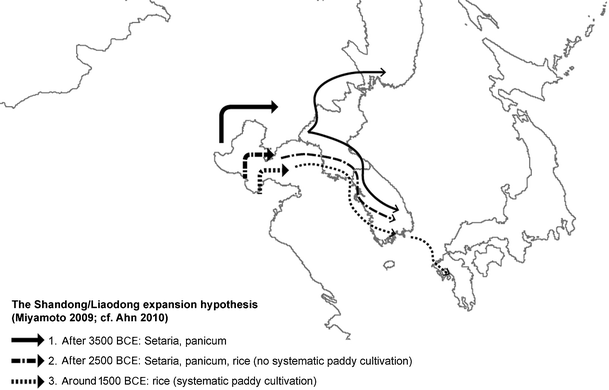
The other by John Whitman provide a synthesis of linguistic and archaeological evidence for the spread of agriculture in Korea and Japan. The image (left) is from Whitman, and summarizes the archaeological picture. He makes a good case that this fits with known linguistic and epigraphic evidence.

Previous papers in this series blogged here (more linguistics) and here (more archaeological).

Wednesday, 21 December 2011

Concatenating rice and language phylogenies: a recipe for single origins?

The literature has been and remains split on singular or multiple origins for rice. The discussion of whether or not all Asian rice can be traced to a single domestication event and a single cultural origin of cultivation continues, and there have been major arguments in favour of it this past year including the high profile genetic modelling paper by Molina et al published in PNAS in May, and a recent contribution on the historical linguistics front. I remain in favour of multiple origins [as per the "rice consilience" paper of last year] -- at least in terms of multiple starts of cultivation of wild rice even if not all of these starts lead on real domestication (in morpholoigcal adaptation terms) or to rice lineages still with us today. Increasingly I am coming to think that modern time-plane sampling, such as modern germplasm or modern minority language vocabularies, is biased by missing out on past diversity-- extinct landraces and wild progenitor populations, lost language diversity. Less diversity sampled will surely tend towards simpler historical reconstructions. Both disciplines also have a predilection for simplifying relationships as trees, which tend to favour single origins. Is there a sense in which genetics and historical linguistics together will tend to be biased towards identifying single points of origin? If so, then when there is evidence to contrary it should surely be given extra weight. A clearly there is an important role for archaeology to try to reclaim some of the lost diversity of the past.


Linguistic homeland for rice?


The new article on "the ethnolinguistic identity of the domesticators of Asian rice" has been published linguist George Van Driem, one of the foremost experts of Himilayan languages many highly obscure and dwindling, especially of the Tibeto-Burman language family has made numerous stabs at the contentious prize of correlating rice agricultural dispersal with historical linguistics, and its inferred history of population movements. In general it provides useful overview of the Austroastiatic and Hmong-Mien reconstruction relating rice and arguments about the homelands of these reconstructed proto-languages. Most archaeologists are probably more familiar with the hypotheses of Peter Bellwood and Charles Higham focused mainly on the Austronesian and Austroasiatic languages in Southeast Asia. (For two recent summary papers by Bellwood, from 2011, see Current Anthropology and the journal Rice). However, there has been considerable recent debate over how Sino-Tibetan (or Tibeto-Burman) languages fit in. The French Linguist Laurent Sagart, an the the instigator of a recent  Cornell conference on the rice and language, has argued in recent years for a shared ancestry of Sino-Tibetan and Austronesian, with an outward migration of rice and millet (Setaria) farmers from central-Eastern China. Van Driem tends to have more of an emphasis on Southwest China through Assam/Burma as a focal area, although he also postulates southwards migrations of  early Hmong-Mien speakers--  likely domesticators of rice (perhaps along the Middle Yangtze). Domestication of  rice by Austroasiatic speakers could have been separate although he seems to tend towards wanting a single origin. As for these Austroasiatic domesticators he places them  somewhere like Assam-- "the Northern Bay of Bengal littoral" (but I presume he does not intend of coastally adapted culture?). In this article Van Driem points to the recent Molina paper as simplifying matters of rice origins, allowing for early cultivation in India to be dismissed. In general the Molina paper and the earlier Londo et al (2006) map are used to suggest a northern Southeast Asia/NE Indian focus for rice domestication, while archaeology is cited mainly for failure to have worked in the required areas. While I would be the first to argue that we need archaeobotanical sampling across Southern China, Burma and Assam I think this paper put too much stock on modern time place samples (languages and genes) and lacks a full engagement with the material constraints that archaeology already provides-- good dates for a domestication process in the Yangtze, good dates for when cereal agriculture, fully formed, arrived in Thailand or Sichuan (e.g. recent blog). These make a dispersal into the Yangtze from a single origin elsewhere impossible, and a dispersal of early rice use into India unlikely (although later introduction of domestication genes is another matter). I do regard as plausible, even likely that there was a separate domestication pathway in the unsampled area, perhaps associated with Austroasiatic, but this must have been in addition to what was happening in the Yangtze and the Ganges. There is a likelihood to would related to the aus-rices-- a group not incorporated in the Molina et al model.


Maps based on modern/recent distributions are a recurrent weakness in the paper. Modern wild rices, like those mapped following Londo et al (or Sampled by Molina et al) are of course biased towards the more tropical South as wild rices are not extant in most of the Yangtze nor in eastern China, but this is a product of environmental change both climatic and anthropogenic-- the extirpated wild rices of the Lower Yangtze, Huai, southern Shandong are of course missing from modern sampling, but archaeobotany has the potential (and is) putting this on the map. Much of the paper  considers the linguistic paleontology for the homeland of  Austroasiatic, in the case of the latter providing a series of maps of fauna that reconstruct to Proto-Austroasiatic, which point towards a southeast Asian (or Southernmost China) distribution. While these provide an important starting point they are also biased towards modern geography rather than early/middle Holocene geography. To take two examples consider water buffalo and elephants, both mapped as going as far north as southern fringes of the Yangtze. But both are species that we know used to range into and north of the Yellow River valley at least through the Bronze Age (i.e. until perhaps 1500-1000BC). Hoffpauir's (2000) excellent chapter on the Water Buffalo in the Cambridge World History of Food provides a good map while a more schematic map occurs in my 2007 paper on non-human genetics, agricultural origins and linguistics in South Asia [pdf]. As for the elephant its former northern occurrence apparently even for Shang royal elephant hunts, provides the leitmotif and title for an excellent long-term environmental history of China,


Mark Elvin's The Retreat of the Elephants. Compare Van Driem's map (top/left) and Elvin's retreat map (lower/right)


[note added 30 Dec. 2011: I have just come across the study by Li et al. (in press in Quaternary International) which has identified Early-Middle Holocene and Bronze Age "elephants" of northern China as the extinct Palaeoloxodon straight-tusked elephants rather than modern Asian elephants (Elephas maximus) but the point still stands since either could the be referent of an early etymon.


As for the genetic single origin (of Molina et al.)

Molina et al (2011a) carried out analysis of demographic history by attempting to model demographic parameters from several phylogenetic datasets using the new generation of collascent models (BEAST and DADI) which allow for multiple branches, bottlenecks and populations. This represents an important step away from single bottleneck models (e.g. Zhu et al 2007; Zhang et al 2009) which only attempted to estimate the correlation between early population size and length of the domestication (bottleneck period) of a single hypothetical origin. They conclude that single domestication of japonica is likely with indica derived from a subsequent bottleneck (underlying grey image below left), their discussion later hedges this with raising the importance of hybridzation/ introgression in indica, although the headline that most take away from this paper is still the idea of a single origin, single domestication event. However origin (start of cultivation) and domestication may not be the same thing.
 This study, however, does not sway me from my conclusion about the evidence for a proto-indica exploited in India before the introduction and hybridization with improved japonica, but reinforces the need for a fossil record. They are unable to sample and model the full range of diversity in all the lineages that have ever been cultivated, however briefly, over the past 8000 years. Their work focused on nuclear genetics, undoubtedly the most informative about evolutionary history in general, but they over overlooked the chloroplast. The chloroplast, which is maternally inherited, differs fundamentally between indica and japonica, nivara and rufipogon, such that there are shared characters between indica and nivara which differ with those of japonica and rufipogon, while other characters in indica are unknown in the wild. This set of chloroplast relationships is indicated in the color overlay in Figure. While they conclude that introgression, which I take to mean pollen flow, from wild rice (into the crop) in India might account for some of the genetic diversity in indica not seen in japonica, it cannot account for the chloroplast diversity, since chloroplasts are not carried in pollen. Thus pollen from wild Indian rices introduced to japonica is insufficient explanation. Instead one would have to posit pollen flow from crops into wild populations (with some nivara-related traits and some now extirpated traits) and that those wild populations retained domestication traits and were subsequently brought back into cultivation. Instead it seems still easier to posit proto-indica cultivation into which cultivated japonica , with a suite of valuable domestication traits, was brought into contact. The genetic background was largely indica into which japonica was the source of introgression, i.e. pollen flow.   I also worry the discernment between their alternative models is not very clear; comparing visually the differences in predicted outputs and actual data (Figure S4 of Molina et a 2011a) it is hard to see much of a dramatic difference between either predictions or fit. In the end I worry that they are forcing us to choose a false dichotomy between common ancestry and gene flow for explaining similarities between indica and japonica, and favouring shared ancestry on the basis an averaged phylogenetic tree across several datasets which may favour a single origin for domesticates much as is true of the neighbour-joining analysis of neutral genetic variation (Allaby et al 2008 or Allaby et al  2010 ).

Something that can certainly be remedied in the next round of models is the exclusion of temperate japonica, which was excluded from the sample set of Molina et al. As we see in the spread of rice in China, it enters the temperate zone of North China already by 3800 BC (based on a direct AMS at Nanjiaokou), where the short-grained is already evident. Based on environment and grain morphology then, we can infer the temperate japonica evolved (through its own post-domestication bottleneck) quite early. It is also from this region (the Yellow River) that diffusion westwards to central Asia and Northwest India is most likely. Therefore I would envision an early form of temperate japonica making the first hybrids with proto-indica. The sequence of bottlenecks associated with rice dispersal event was surely more than two, and some of these may have been associated with quite strong selection pressures (such as for or against photoperiodicity) as rice adapted to new ecologies: just two bottlenecks is unrealistic.  

Nevertheless Molina et al provide what probably a more realistic molecular clock estimate than has been possible before, with an initial domestication placed at 8200 BP (upto 13000), and the indica bottleneck at ca. 3900 BP. The former fits quite well with current archaeobotanical evidence for the beginnings of morphological change in Yangtze rice, and the later  date is spot on for the first appearance of the “Chinese horizon” in Pakistan and Northwest India. If this study is taken as representing the main stream of fully domesticated rice then it seems to be closing on elements of reality.

I would regard many of the problems identified above as conceptually relevant to historical linguistic hypotheses. Linguistic reconstructions inevitably work backwards from a modern time plane (although some may benefit from old texts too), towards a reconstructed common ancestor. This is like the domestication bottleneck in that while its form may be inferred from the modern data (given certain simplifying assumptions), lost side lineages, may be overlooked, and shared ancestry may therefore be easier to see than parallel developments. The dominance of the single japonica narrative found by Molina et al. (2011a) is much like the dominant Austronesian paradigm in its downplaying of substrates and language levelling processes. Indeed, recent perspectives on the later history of Southeast Asia, such as James Scott's (2009) The Art of Not Being Governed, have emphasized that ethnic affiliation has been flexible and that disgruntled overtaxed rice farmers have recurrently taken to the hills and joined the shifting-cultivator tribes, switching identity and language (at least for the past 1000 years). This is probably one factor contributing to the remarkable typological convergence across Southeast Asian language families and this may obscure early history. I find this conceptually similar to the observation that over time domesticated crop varieties come to resemble each other more than any resemble wild progenitor populations, leading to false ascertainment of monophyly (Allaby et al 2008; 2010).


. . .
My own working hypotheses on how rice phylogenetics and especially historical linguistics can be fit together within the framework of evidential constraints provided by archaeobotanical evidence, should be published soon in a special issue of the journal Rice [on-line here] arising from the Cornell conference....let the discussion continue and may it inspire new archaeobotanical sampling and genetic modelling. 

Thursday, 8 July 2010

A dialog on rice in Indian cultural history

I received the following queries about rice, posted on the Indo-Eurasian discussion list. Which I will endeavour to answer here. This queries arise from a colleague having read my recent “consilience” review article on rice.
- Does this new evidence (of proto-Indica and japonica entering fromChina via a precursor of the silk road) conclusively rule out the association of rice cultivation with a hypothetical 'Austric' package(I mean, dispersal of Munda-speakers INTO India)?
No. These processes are not mutually exclusively. The genetics of rice is complex and implies many episodes of hybridization between indica and japonica lineages, and with the aus and tropical japonica groups which are now increasingly seen of distinct subgroups of indica and japonica, respectively. Just have a look at the genomic data published by McNallay et al last year, and you will see how recurrent and extensive hybridization has been. A single entry of japonica into South Asia is inandequate, and we tried to reflect this in our ‘Thrust 10’, but there is also presumably some mixing between thrusts 6 and 8 in the Assam region. Indeed it is the aus-rices of Assam and Bangladesh that shows that highest levels of hybirdization in McNally’s study.
- Does this lend credence to the theories of South Asian homeland forAustroasiatic languages (including perhaps pre-proto-Munda and ancestral language of Mon-Khmer languages)?
No. The current archaeobotanical evidence can fit with Austroasiatic origins either to the East to the West. In my own writings I have gone back and forth from supporting the immigration ofMunda (my 2003 paper on Dravidian [pdf]) or emigration from pre-Proto-Munda (my 2007 paper in the Petraglia/Allchin volume). I have actually shifted back more towards seeing the Munda coming into India from the Northeast.  In either case Proto-Munda agriculture was not particularly rice focused, indeed reconstructible rice vocabulary is meagre, but focused on tubers (including taro), millets (and it is unlcear if these are the Chinese or Indian millets originially), and pulses, water buffalo and maybe pig. It seems clear that Proto-Munda is heavily influenced by Dravidian and pre-existing Indian agriculture through the adoptions of sheep/goat, zebu, and Indian pulses. The archaeological and archaeobotanical evidence, however, is strongly against an “Austric” hypothesis (sensu Blust) that see one origin of rice driving all the major language expansions of SE Asia.
- With this new evidence, could we say anything about the familial affiliations of Language X and Harappan languages (Kubha-vipas and Melluha -- let's call them Language Y and Language Z; I personally don't like the terms like Para-Dravidian, Para-Munda, Para-IA etc.)?
No. I increasingly think that Para-Munda is highly misleading. Kubha-vipas seems to have as uch in common (in not more) with Mon-Khmer and even Austronesian as it does with Munda (this is clear from vocabulary comparisons used by Kuiper, which as Osada has pointed out often include Austronesian words; and from the “rising” versus “falling” order of the language (sensu Donegan and Stampe 2004). These might all be labelled as broadly “Austricoid” but I can not see how these can be connected with agriculture and presume that shared ancestry must be much older than that…. But this is probably a discussion for another time….


has a different history than that of rice, and agriculture predates the introduction of rice in all regions of civilization viz., Indus Valley, Gangetic plains, eastern India and Neolithic southern region of Andhra-Karnataka- Is it correct to assume that the dispersal of agriculture in India
The patterns are different in different regions: there is neither one story of agriculture in India (e.g. my Journal of World Prehistory paper of 2006 [pdf]), nor one story of rice in India. Agriculture clearly precedes rice in the northwest (the Indus), in the west (Gujarat and Rajasthan), in the northern and southern Deccan. Through most of the Indian savannahs (Gujarat through the South Deccan) early farming was based on indigenous millets and pulses, rice came late (mainly after 500 BC) and even in historic times rice was a relatively minor component of overall agriculture: I take this for example from my recent research on the archaeobotany at Paithan in Maharashtra—in the early Early Historic and Early Medieval period rice is presence but millets are dominant, and wheat and barley are also more frequent than rice. Of interest is that kodo millet (Paspalum scrobiculatum) is hand down the most dominant crop on the site, with the African millets including sorghum, which are so prominent today, making only a minor show. Agriculture and diet has been dynamic, and we do a dis-service to that variety by obsessing about rice. As explored in an interesting paper by Monica Smith (The Archaeology of Food Preference), rice does appear to have been a preferred crop of higher status and for culinary reasons, and probably also by states as it is highly productive and is therefore a favoured by state taxation. A similar point has been made compellingly in a recent history of political ecology and shifting cultivation in southeast Asia, James Scott’s book The Art of Not Being Governedin which he explores how the lowland states of mainland Southeast Asia have always been built on fairly intensive, and easily taxable rice agriculture, while the unruly and difficult to govern peripheries have been the realm of shifting cultivators and those fleeing oppressive states.


ariki, arici (tamil), brinj (persian) etc. [as discussed in Witzel 2006.  South Asian agricultural terms in Indo-Aryan, and Southworth 2005]?- What about the rice related terms like vrihi (vedic), vari (telugu),
Many of these terms probably are related, although I am less then convinced that all of them are. Some of the Dravidian terms look like they may be semantic shift from words that originally names of millet.  But whatever the case the spread of rise and its rise in importance in economic and prestige terms means that names of rice would have been widely borrowed. Clearly the spread of rice into the Persian world came from India (although the preferred fragrant rice varieties of Persian had their ultimate genetic origins in Southeast Asia—as did most fragrant rices, as indicated by genetics of the most-common BADH2 mutation-- but must have moved via cultivation India). This could have been as much a process of elite dominance, in regions like much of South India where rice was initially a fairly minor crop, and have little to do with population movements as such. I would look to parallels in things like the spread, borrowing and diversification of terms of pepper in European and Western Indian Ocean languages—which testified to the long importance of this plant product in trade—it appears broadly related from Thai Phrikthiy, Swahili Pilipili (hence Brazilian periperi), Portuguese pimento, Turkish biber, Greek piperi, all ultimately from Sanskrit. Oddly from Sanskrit and not Tamil as black pepper is clearly indigenous to Southwest India. A similar pattern holds for names of coconut, far more prominent as a crop in Southern India than in the Sanskrit north. But these patterns must have some reflection of trade routes and social valuation. On the other hand most of the world has taken its names for Mango from Dravidian, yet the mango is not originally native there, but most cultivated mangos have their origins in Assam or thereabouts, but I know of no linguistic trail. Instead it was Tamil and/or Malay sailors who had borrowed from Tamil who did the most to spread knowledge of this fruit around the Indian Ocean. …I would note that putting together histories such as these and anchoring them in archaeobotanical evidence and genetics is a major focus of the Oxford based SEALINKS project, in which we have started new archaeobotanica sampling in Kerala, Sri Lanka, and coastal Kenya and Tanzania…


- Is it still correct to assume that the South Dravidian form 'arici' has been transmitted westwards, probably by maritime trade to result in Greek oryza, oryzon and Arab. ruz, English rice? You see, 'arici' is one of those words that compels people like Karunanidhi, the current CM of Tamil Nadu, to bombastically claim that "Tamil is the mother of all languages in the world!" (tamizh ulaga mozhigaḷukkellaam taay mozhi ennum perumai peRukiRatu)!
Certainly the term for rice has been translated Westward from Tamil, but as  the examples of pepper and mango indicate this has much to do with patterns of early historic trade, and which middlemen give commodities their name, than anything else, and perhaps little to do with ultimate ‘origins’ or Linguistic superiority. South India played a major role in Indian ocean trade throughout the 1st Millennium AD and upto the European colonial era, and thus many Tamil names have become attached to things; so too Portuguese and Spanish played the major role in transmitting the names of New World crops throughout Eurasia. 


(These queries come from Suresh Kolichala, who is researching ancient Indian recipes and cookbooks, which I very much look forward to learning more about!)