Showing posts with label Setaria. Show all posts

Thursday, 12 February 2026

Post-Domestication regional evolution

UCL Archaeobotany
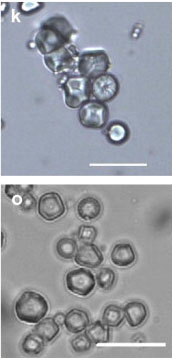
Setaria italica grain variation:
above, from Gansu;
below, from Karnataka

It is true that evolution never stops--a suitable point to reflect upon on Darwin's birthday (12 Feb 1809) Some authors, would therefore insist, that domestication processes never cease and are always unfolding (a key argument in the recent book by Robert Spengler, Nature's Greatest Success), but I think there are grounds for differentiating the initial domestication episode that separates cultivars from the their wild population and later diversification and regional adaptation that took place within geographical subsets of a crop. In a paper in 2009, "The nature of selection during plant domestication", we drew attention to some differences and different expectations between domestication and diversification [incidentally that paper was also published in February 12, the 200th birthday or Charles Darwin]. The expectations are that diversification may occur over shorter timescales, differ between regions, and may (but may not) involve some conscious selection, based on farmer preferences. As archaeobotanical datasets have become larger and from more regions it offers the potential to compare and contrast how crops were evolving and differentiating across regions-- at least in those traits we can observe on archaeobotanical material. As noted in a recent blog (Bigger Beans...) there is clear evidence for selection for larger seeded legume crops around the greater Mediterranean some time after the classical period. While Grasso et al. (2025) argue for intentional selection in southern Italian farmers of the Middle Ages for larger broadbeans, I suggested in a previous blog that this might not be so because of the striking parallels across lentil, chickpea, grasspea and broadbean for macro-seeded forms around a wider Mediterranean world. This coincidence suggests to me an unconscious process of parallel evolution/adaptation to something in the ecology of bean farming in Late Antiquity to the Middle Ages (perhaps heavier tillage and also less incidence of water stress).


Aspects of grain size and grain shape are easily measured, and indeed have been measured for many years. Last year, in a large compilation of grain metrical data from archaeological assemblages acorss Eurasia, together with Rita Dal Martello, Robert Spengler and other colleagues from the Max Planck archaeobotany lab, we considered Contrasting diachronic regional trends in cereal grain evolution across Eurasia: a metadata analysis of linear morphometrics from the ninth millennium BCE to today. This study considered barley, free-threshing wheat (presumablty predominantly hexaploid bread wheat), and the millets of Chinese origin, Panicum miliaceum and Setaria italica. All four of these crops have pan Eurasain distributions, with dispersals beyond their regions of origin beginning in the Neolithic and having largely reached their maximum distributions by the end of the Bronze Age. As these crops came into a region one can expect them to adapt to local conditions, both ecological and cultural. What we found that is most striking, however,  is parallel trends in size/shape change in different crops in the same region, and often contrasting directions of change in different regions. While one might expect this with wheat and barley, that might be grown together in the same season, to find this across these cereals and millets is striking. The image above compares regional trends in grain length and width in free-threshing wheat, while the image below compares trends in the millets. Over the past 3000 years wheat and both millets tend to get longer in Central Asia; this is also true of both millets in East Asia. By contrast in northern Europe grains of all three species are becoming shorter over the same period. In Europe, wheats on average become shorter and fatter in north, but longer and skinner around the Mediterranean. In Central Asia wheat behaves more like southern Europe and the Near East. 


This all points to different selective environments in different regions. Sometimes shared across crops. Previously smaller scale, and shorter timeline studies have suggested that as wheat moved east to China grains became shorter and plumper (Liu Xinyi's "virtue of small grain size"), perhaps to make them more millet-like for cooking in East Asian boiling traditions. It is not clear such patterns hold up. Would such an explanation also be suitable for the trends in post-Roman northern European wheat? More problematic still is that the large dataset in Dal MArtello et al. (2025) is that decreasing grain length is seen in wheat starting in central Asia around the same time as its arrival in East Asia. These regions we might expect to have different cooking traditions and different cultural selection environments? The trend reverses around 2000 years ago with grains again getting larger.

An unambiguous explanation for this is elusive. It could be that there were some environmental factors in each region acting across crops. These need not be directly on grain size either, as grain size may scale allometrically with selection on other aspects of size, like plant height. Shorter and smaller plants might be more resistent to lodging in some kinds of weather or more drought tolerant. For example the Indian shot wheat, Triticum sphaeroccum,  has particularly short grains, as well as shorter plants, which seems to evolved twice in South Asia as adaptations to extremely high temperatures and evapotranspiration, even though sphaerococcoid grains reduce grain weight and overall yield (see Cheng et al. 2020).

The more general point is that crops have always been evolving and differ across regions. The foxtail millet (Setaria italica) grains at the head of this post contrast short plump grains from China (Lixian, Gansu) and skinner grains from India (Sanganakallu, Karnataka) both from the UCL archaeobotany reference collections. Explaining these differences may be hard, but what is clear that archaeobotany and systematic measurement of more assemblages can provide a window on tracking how regional populations varied across time.


Saturday, 20 July 2019

Panicum domestication and early sedentism in Northeast China


For the past decade the Xinglongwa culture of eastern Inner Mongolia (Liao River valley) has been regarded as a likely cultural context for the domestication of common millet (Panicum miliaceum), on the basis of significant quantities of Panicum grains associated with some of the many houses excavated at the site of Xinglonggou (see, e.g. Zhao 2011). Recently, new excavations by a Chinese-Israeli collaborative team (with some London archaeobotanists) explored parts of two new small settlement sites of this period, Jiajiagou (5950-5700 BC) and Tachiyingzi (5550-5450 BC), including intensive flotation, have been published this week in PLOSone. At both sites a single dwelling was excavated and sampled, and the archaeobotanical data indicate a predominance of wild plant foods, including walnuts, apricot endocarps, hawthorns, Phellodendron, but Panicum miliaceum is also present is small quantities-- 16 in total at both sites, with more and higher ubiquity at the later site. Most of these Panicum grains are more elongate then plump, with size and L/W ratios that correspond better to Panicum miliaeceum subsp. ruderale, known today as a weedy species but probably descended from, or at least comparable to the origins wild progenitors. We take this to suggest that grain size/shape was still under going evolution over the course of the 6th millennium BC, and thus it may not have been finished evolving into its domesticated form. This fits the now recurrent pattern of protracted domestication processes in cereals (explored previously when "de-centering the fertile crescent", and demonstrated more statistically in Allaby et al "Geographic mosaics and changing rates of cereal domestication").

These data, along with those from Xinglonggou indicate that while Neolithic sedentism had been established in Northeast China by the early 6th Millennium BC, the evolution of domesticated Panicum miliaceum and the establishment of agricultural economies still took rather longer. Another conclusion of the paper is that sedentism and this domestication process took place during stable and quite conducive climatic conditions. This argues against the hypothesis that domestication in this case was driven by climatic stress, or that it should be linked to major climatic fluctuations that characterize the start of the Holocene (a hypothesis promoted by Bar-Yosef 2011, amongst others)

It is worth noting that the later site (Tachiyingzi) also has the presence of a few Setaria italica and S. viridis, and a couple more plump grains (pictured above). While none of these grains was directly dated there is some possibility that more fully domesticated grains will prove to be intrusive. Amongst the direct AMS dates, on wild foods, four proved to be 6th Millennium BC, but one date on fragments from lotus seeds turned out to be intrusive and late Bronze Age. This highlights the need for more direct dating of crop remains, a point highlighted by recent debates over the arrival of wheat in Late Longshan China, for which numerous false alarms have been dismissed via direct radiocarbon dating (see "Assessing the occurrence and status of wheat in late Neolithic central China: the importance of direct AMS radiocarbon dates from Xiazhai").      

So the case for a millet domestication in Northeast China in strengthened. This does not rule out other dometciation centres-- which there must have been for Setaria italica at least, and perhaps Panicum milieceum. Domestication can be regarded as taking place alongside and after the emergence of sedentism, but further data are needed to better document this, and to assess the extent to which initial cultivation  of wild millet was linked to the shift to sedentism or not. 

Thursday, 21 February 2013

Earlier sorghum in Sudan


I have recently been made aware of a small report in Nyame Akuma on Kasala (northeast Sudan), where Italian researchers have restarted research which can be regarded as following on from the 1980s survey headed by R. Fattovich. The new work has included the study of some plant impressions in ceramics published as "Sorghum exploitation at Kasala and its environs, North Eastern Sudan in the Second and First Millennium BC" by Alemseged Beldados and Lorenzo Constantini in Nyame Akuma vol. 75. As its title indicates this study does confirm the present of Sorghum bicolor, plausibly (but not definitively) domesticated, in ceramics from the site of Mahal Teglinos and some from near by survey collections. It reports examination of 25 sherds of which 11 from Teglinos and 11 from survey have sorghum.

As many will know I have been critical of some previous sorghum identification from impressions, in particular coming out the lab in Rome (most infamously those from Oman and Yemen). As a result, in various tallies of early sorghum I have always regarded the 1980s report of Sorghum of the Kasala region survey as requiring a big question mark next to it (e.g. "The economic basis of the Qustul splinter state"). The sorghum here, at least in fig 4, looks legitimate. The suggestion that grains shape (narrow versus wide) can be used to identify both wild and domesticated sorghum is more problematic. Meroitic Umm Nuri produced very very thin but apparently domesticated sorghum (published by me in Sudan and Nubia 2004).What is really needed is clean views of spikelet bases (for wild versus domesticated hulled forms) or evidence for still attached rachillae (especially in free-threshing forms).

I now believe that sorghum is there in Kasala, dated by ceramics (Mokram group) and association to 1500-500 BC. This is important news, as it takes sorghum earlier probably than any of the find in the Nile Valley, which are mainly Meroitic, and with possibly earlier Napatan sorghum at Kawa (in Sudan and Nubian 2004). This is a relief given that it is India before this time by at least a couple of centuries, and maybe more (for an updated review of early African crops in South Asia see by papers in Nicole Boivin, either that in J. World Prehistory on Arabia, or the Etudes Ocean Indien paper [in English]).

Some of the other identifications, notably cowpea (Vigna unguiculata) reported from one impression remain unconvincing, at least as photographed, and I really cannot except them on this sort of evidence. I would also expect pulse seeds to make poor temper for pottery. While we might expect this species in this region and period, as it was in cultivation prior to 1500 BC in West Africa and had arrived in India too by this time, I'll await more convincing evidence.

It is a pity high quality imaging, especially SEMs, were not made of the casts as, then one could see finer details of morphology like characteristic hairs, etc., that really clinch an ID. (See, for example the unicellular  e.g. w&v in the images from the Essouk archaeobotanical report, also a rachis stalk which suggests it is domesticated).

Also tantalizing is the evidence for millet, Setaria, impressions in 3 sherds. As illustrated, one could also propose a Bracharia and we really need better resolution SEMs and husk comparisons to get this to species level. Nevertheless it is plausibly a fit for S. sphaceleata, which is of particular interest as the  "lost" millet of Nubia,which we have evidence for cultivation of from Napatan to Medieval times (Kawa, Qasr Ibrim, Nauri). The origins and history of this lost millet of Nubia really needs to be chased down. It has gone extinct from Nubia in the past millennium, replaced by Setaria italica.

(Thanks to Mike Brass for bringing this paper to my attention)

Thursday, 8 March 2012

Does starch evidence push back foxtail millet domestication?

A recent article in PNAS, by Yang Xiaoyan et al., on starch grains (and some phytoliths) from two early Holocene sites in northern China (approx. 9500-7500 BC), pushes back evidence for the early cultivation of foxtail millet. This builds on recently reported identification criteria for millet starch.  This paper is an important contribution to the earlier prehistory of grass and millet exploitation in Northern China and provides important new evidence for the discussions and debates about the timing, areas and processes of millet exploitation and initial cultivation. For on thing it highlights the importance of grasses, including a large proportion of millet grasses, in the subsistence of later hunter-gatherer, or cultivator transition, northern China. This hints at a contrast with nut-hungry and acquatic-focused south (Yangtze). These new data make foxtail millet exploitation, and possible cultivation, at least as early, if not earlier, than the claimed early Panicum from Cishan (although in the latter case, hard evidence for cultivation rather than gathering remained elusive). Phytolith data indicates the occurrence of Panicum miliaceum types only from late Donghulin. Taken with other recent finds this is suggestive that Panicum and Setaria were not brought into cultivation together, perhaps each more than once, and separately, in different parts on northern China. The bringing together of these two crops, fully domesticated, in an integrated system, would seem to be a key transition, yet to be identified, but which must have happened by the time of the emergence of the Early Yangshao tradition in the first half of the 5th Millennium BC.

The trends that Yang and colleagues have found, towards more of the larger Setaria italica like starches are suggestive a subsistence shift, and potentially as the authors argue, of changes evolving in foxtail millet, as part of the domestication process. More data from more sites and periods are needed, however, to confirm whether this a real trend. It would also be nice to see what these kinds of ratios look like on later sites with clear macro-remains of domesticated foxtail millet.

Nanzhuangtou and Donghulin as early Holocene/terminal Pleistocene transition sites with early pottery are often cited as the precursors of more typically Neolithic miller cultivators but have lacked much of any archaeobotanical evidence. These findings will take on an obvious significance to those interested in the early Holocene or early agriculture in Northern China. This study is also a good example of careful archaeological starch research, and is therefore wider methodological interest. Although starch grain research has become increasingly popular in China, some studies have been rather unconvincing, especially with regards to methodologies for identification and for being clear about uncertainties. That is not the case here, where a clear methodology for identification of millet-type starch grains has been employed which is in part qualitative and in part quantitative and it includes a clear recognition of some of the uncertainties in secure species level identifications, especially of smaller and less fissured starch grains. It is also clear that the reference collection of modern material that has been studied is the most extensive to date for Chinese grasses and this increases greatly the likelihood of their reported identifications. The inclusion of control samples of sediment and loess from Donghulin to check for contamination is also methodologically very important, since modern contamination will always be a concern in starch studies. It is also good to see consideration of the presence of immature starches, since immature millet grains are a significant component of charred assemblages, and significant present on immature/unfilled spikelets has been noted in Chinese agricultural texts throughout history, since records in the Han Dynasty. The recognition of carbonized immature Panicum grains has recently been bolstered by an experimental study blogged previously.

Sunday, 5 February 2012

Millet starches: towards a systematic and quantitative approach

Yang Xiaoyan et al. have published their latest key to millet starch identification (for China) in J. of Archaeological Science "From the modern to the archaeological: starch grains frommillets and their wild relatives in China". This is an important development, partly because it is the largest comparative study yet from that part of the world (although arguably still not large enough in terms of taxa and populations!), but mainly because it provides some highly plausible and well-quantified guidelines on millet starch identification. It shows quite clearly that there is quite a lot of variation within a grain, a species and genus, the Paniceae, but also degrees of underlying similarity. The take home message is that every individual starch  is unlikely to be identifiable to the same level, to species or genus, but that some may be highly suggestive (the especially large and wrinkled examples are more common in Setaria italica than in wild Setaria or Panicum), and if on an assemblage level morphometric can be used to assess the probability of certain taxa. In other words it is the first step in building a probabilistic, rather than some qualitatively absolute, determination that the Chinese millets or there wild relative were present. Interestingly it indicates that Setaria italica is in principle far more recognizable than Panicum miliaceum, which has more 'generic' millet-grass starch. This means that rather than trying to take a small sample of few starch grains and pronounce a species presence that may not be believable, a more stasticial approach can be taken to determine a degree of likelihood. Such a quantitative apporach also open the possibility of tracking assemblages changes, which in turn might be connected to other lines of evidence for agriculture change or even plausibly put together in models about population change such as domestication processes, since Setaria viridis and Setaria italica differ in their starch grain assemblages. It also raises another potential area of investigation, which require further work, environmental conditions, since there does appear to latitude-related variation amongst  Setaria italica populations studies-- so further work is needed. The this is the best step in the right direction we have seen increasingly popular Chinese starch research world.

Tuesday, 6 December 2011

More on rice and millet in South China and Southeast Asia


Some new publications highlight new research and new researchers working on the archaeobotany of parts of China and Southeast Asia. Three recent papers all from among a new generation of archaeobotanists report and review evidence for archaeological rice and foxtail millet (Setaria italica) in the parts of China and in Thailand. Recently published in Archaeological and Anthropological Sciences, is a paper by Nasu et al. on "Land use change for rice and millet at Chengtoushan" a Daxi era (4500-4000 BC) site in Hunan province. This reports in detail the weed flora, mainly indicative of wet rice cultivation (on , as well as discussion of probable rainfed foxtail millet, the earliest South of its probably northern Chinese areas of origin, as well as plausible Perilla and melon (Cucumis melo) cultivation. Two papers have also appeared in the journal Rice from a conference on agriculture and language-spread held at Cornell in September, both by PhD students. One by Jade Guedes, who is carrying out new primary archaeobotanical research in Sichuan province, reviews "Millets, Rice, Social Complexity, and the Spread of Agriculture to the Chengdu Plain and Southwest China." The other, by one my PhD students at UCL, Cristina Castillo, reviews the archaeobotanical record from Thailand: "Rice in Thailand: The Archaeobotanical Contribution". Both also discuss weed flora, including evidence for wet rice cultivation in the case of the Chengdu Bronze Age and dry, rainfed rice in the case of Iron Age southern Thailand.

Friday, 9 July 2010

Gansu Province survey archaeobotany

A recent issue of the Chinese Science Bulletin contains an archaeobotanical paper from what appears to be a new archaeobotanical research group. An ChengBang et al. report evidence from survey archaeobotany in Qinan and Li counties, and as such follows in the path laid by flotation as part of field surveys published previously from the Yiluo Survey (Lee et al 2007) and the Ying Survey (Fuller and Zhang 2007; see also our GIS study in Journal of Archaeological Science). This new study is based on 96 samples, from something like about 40 sites (although this is not entirely clear). Unfortunately the full dataset is not published, and we are given a glimpse of it through summary data presented as bar chart of absolute counts of Panicum and Setaria grains. Not the most informative means of comparing across sites and periods with very different sample sizes. The presence of rice (7 grains in the Late Yangshao) and wheat and barley (from the Western Zhou period) are only referred to in the text description. No reference is made to any other species, whether pulses, fruits or weeds. One novel addition to the study was a stable carbon isotope study of the millet grains, which shows that Setaria tends to have a somewhat higher value than Panicum, as expected since although both are C4 plants they have different forms of the C4 mechanism. A novel technique but the results are still close enough that this is unlikely to replace morphological identification! While it is nice to see more archaeobotanical research being carried out in China, the attention to only cereals, the lack of discussion of archaeological context (it is even unclear which sites numbers are which period), a less helpful method of quantification, and the lack of full details makes this study a rather frustrating addition.

Tuesday, 25 August 2009

Millets and Mistakes

In Last week's Science the journalist Andrew Lawler, published an extended series of News Focus articles on Chinese civilization. The central piece focuses on the origins of civilization, highlighting for example the impressive urban settlement of Liangzhu (a kind of walled Neolithic Venice, many centuries before the Shang Dynasty) which ought to be better known to world archaeology than it is. (I had my own tour of some of the mutliple sites that compose it, and its multimedia museum, with site director Liu Bin in July). Also of note is his one page sidebar entitled "Go East, Young Archaeologist" on the specialists trained outside China, which features Jimmy Zhao, who has been instrumental in getting serious archaeobotany established in the minds and manners of Chinese archaeologists, and has been promoting flotation in China for the past decade.

What I would like to pursue here, however, are some observations on archaeobotany, and pick out some mistakes or misleading statements, with reference to the origins of millet agriculture which features in another sidebar, "Millets on the Move." Lawler begins which a point that seems to look increasingly true, that millet(s) were cultivated and presumably domesticated before rice, and were the staple foods of the northern China region where the classic Chinese civilization later emerged (focused on Erlitou rather than Liangzhu). He makes reference to the recent early dates (ca. 8000 BC) associated with Panicum miliaceum husk (lemma/palea) phytoliths reported from storage pits at Cishan (blogged previously). However, I must disagree the there is any hard evidence that the Panicum miliaceum at Cishan was morpholoigcally domesticated (i.e. non-shattering, with marked increased grain size, etc.), nor is there even clear evidence for cultivation, unless one assumes that large stores could only be ontained from cultivation, which in turn implies that we know the Early Holocene wild ecology of this species (which we don't) and that it did not form extensive collectible stands, as wild wheat, barley or rice or teosinte do (see discussion on my earlier Dadiwan blog and comment from L. Barton). I also must reiterate that there is much about the archaeology of the Cishan find (stratigraphiy, cultural context, and dating that require further work.

A lack of scientific clarity in Lawler's piece, however, is indicated in that millet is always used in the singular and the species (there are two major domesticates in ancient China) is never specified. And things get worse... as Lawler explored the hypothesis (favoured by Martin Jones and Cambridge millet group) that Panicum miliaceum (but NOT Setaria italica) spread before 5000 BC acroos temperate Eurasia from China to India. This hypothesis is plausible, but there is not yet any good clear data for this, only hints that it might yet emerge from ongoing and unpublished genetic work. Lawler acknowledges an alternative, which I would favour, that Panicum may have had a seperate domestication in the west somewhere near the Caspian and Black Seas. Well-dated, clearly-identified and numerically large assemblages of Panicum miliaceum outside China are mostly millenia later. To illustrate his case, Lawler produces a map which shows a major lapse in scientific clarity:

This map, although redrawn from that in Hunt et al (2008), is extremely mis-leading, especially when coupled with the text that hook-line-and-sinker swallows the notion that "millet" spread in the early Neolithic to Europe, without apparently realzing what "millet" is (or millets are). Millet is more than one species anyways despite the English misnomer-- in modern India one can find 12 domesticated species of "millet" in cultivation, with several more restrcted to Africa). The early dispersal of "millet" that Martin Jones favours, applies to broomcorn millet (Panicum miliaceum), as does the recent early find at Cishan, although Neolithic North China also boasts foxtail millet (Setaria italica), by about 6000 BC or so. For the map of Lawler, however, the "millet" in the caption actually means the genus Panicum or the genus Setaria, and does not require that these be cultivated or domesticated finds. What is most grevious in this map are the dots in Western Asia and Egypt. This map in its original, illustrated all reports identified to genus level of Setaria or Panicum-- both of which are major genera of grasses with multiple wild species-- in which the error margins of calibrated radiocarbon dates may place them as early as 5000 cal.BC (although often the dates are likely to be later). The dots in Western Asia, include sites such as Abu Hureyra in Syria, which is a well-known site to students of early wheat and barley agriculture. At this site it is argued (by Hillman et al. 2001) that wild rye and perhaps two-grained einkorn were brought into cultivation in the Late Pleistocene during the Younger Dryas, while later PPNB levels have evidence for domesticated wheats, barley and other Near Eastern crops. "Millet" is represented at this site by small number of wild Setaria, of either S. pumila or S. verticillata, and certainly not Setaria italica nor Panicum miliaceum. Other dots in Syria and Cyprus include Tell Mureybit, El Kowm, Bouqras, and Khirokhitia, which Lawler has now awarded domesticated Chinese millet in the Pre-Pottery Neolithic. Meanwhile, three dots occur in Egypt, representing Early Holocene "Neolithic" sites like Nabta Playa. These sites are Neolithic in the sense of having pottery but not in having agriculture. Archaeobotanical evidence from these sites shows wild savannah grass gathering, including wild sorghum and a range of other species, including wild Panicum sp. and wild Setaria sp., but there is certainly no suggestion that these were cultivars or related to S. italica or P. miliaceum. While Hunt et al (2008: S6) were explicit in trying avoid the pitfall of "over representing.... securely identified domesticated finds", Lawler appears to have jumped headfirst into this pit!

The dot in Iran (representing Daulatabad R37) is also problematic as early millet finds there are more likely local wild species, while evidence for domesticated Panicum miliaceum is probably later form the latter Third Millennium BC at Tepe Yahya (a time period which fits with the reports of broomcorn millet appearing in Yemen before 2000 BC-- see the recent Boivin/Fuller review dealing with the prehistory of Arabia). A more detailed and critical look at the sites in Europe would show that these also include numerous Setaria sp. and some Panicum sp. reports that are of local wild species. In addition, quantities of reported Panicum miliaceum are extremely low and it remains entirely plausible that these represent wild, weedy Panicum miliaceum subsp. ruderale as a weed rather than domesticated broomcorn as a crop-- a point admitted in the Hunt, Jones, et al. paper from which the map derives (see page S14). Of course there is a bias towards focuing of wheats and barley in European archaeobotany, and careful documentation of the early Panicum has been less thorough. More archaeobotanical efforts are needed in this direction, like that being pursued by the Cambridge millet group, but dumbing-down for, and misleading, the educated readers of Science is not.

Thursday, 25 June 2009

Millet watch: Setaria genetics

Plant Physiology for January includes a short, useful review on the genetics of foxtail millet, by Doust, Kellogg, Devos and Bennetzen. From this we learn that work is underway to prepare a full genome sequence for Setaria. It usefully provides an bibliography on the phylogenetc and genetic diversity studies in Setaria italica and viridis. Most of these have concluded that Setaria italica is polyphyletic (work by Kawase, Fukunaga, etc.), although the number fo domestications versus the role of introgression with local wild populations deserves further research. It includes some discussion of architectural changes, relating to growth habit--especially apical dominance-- that were important in the domestication process of this species (and also most other cereals).