Showing posts with label Southeast Asia. Show all posts

Friday, 17 January 2020

In Memoriam Steven A. Weber

It is with profound sadness that I record the passing away earlier this week of Steve Weber (1954-2020), an archaeobotanist, a friend, a sometimes sparring partner (on issues archaeobotanical), a sometimes co-author, whose ideas and work greatly enriched my own. For most archaeobotanists, he is probably best known for his work on Harappan plant remains, from his book Plants and Harappan Subsistence, to his co-edited volume on Indus Ethnobiology. Although his PhD (Univ. Pennsylvania, 1989) was on the Harappan site of Rojdi in Gujarat, India, he had previously worked in the American Southwest, especially in the Hopi region. After degrees at Northern Arizona State University and attending the first Ethnobiology meeting held in 1978 in Prescott Arizona, he helped to found the Society of Ethnobiology, with Steven Emslie, and edit its Journal of Ethnobiology that launched in 1981 (recounted in his article of 1986). The first issue of that journal partly celebrated the ethnobiological work of the late Al Whiting, which Steve Weber helped to bring to publication as Hasasupai Habitat, which looked in detail on resource use and settlment system of a native group in part of the Grand Canyon region. Steve departed Arizona to take up his PhD work at Pennsylvania and to establiosh the first really large scale machine flotation program of archaeobotany in the Indus valley region at the site of Rojdi with Prof. Gregory Possehl. He later took over the archaeobotany at the excavations at Harappa throughout the 1990s.

He was professor in the Anthropology Department at Washington State University, where he taught from 1994 onwards. On his webpage there, he describes himself as an "archaeologist and archaeobotanist working throughout the world" and working on the themes of "how and why people adopt new subsistence strategies, and how change in subsistence systems relates to change in material culture and settlement systems." He was always quick to point out that he was a field archaeologist first, but he was also a knowledgable and enthusiastic botanist. He certainly did get around-- we had meetings and encounters in France, in London and Cambridge, in the Delhi airport, n Lucknow, in Zhejiang and Kyoto, in San Francisco and Vancouver, Canada, and no doubt others I have forgotten. He was also intently engaging in conversations, full of ideas for further analysis, and extremely generous with his ideas. Sometimes they were quite accidental. We met once in the Delhi airport, both transiting and tired from long flights from abroad, but over coffee we had a conversation about potentially fundamental differences between wheat and barley on the one hand and millets on the other, and whether or not there was something inherent in the productivity of the big-grained cereals that meant they were more likely to support urbanism. Ideas he later developed in his paper "Does size matter?". In this article he suggests that large-seeded crops have larger and deeper root systems, making them much more productive when soils are well-watered in contrast to the more conservative small-grained crops like millets. While one can find exceptions, like northern Chinese urbanism based on millets, there does tend to be higher productivity in the larger grains cereals, allowing for the support of denser populations.

One time we arrived in Lucknow together, and Steve's luggage has been lost, so we spent the afternoon shopping for clothes for him. (He bought quite sensible clothes, while I opted for a rather louder shorts-- see below). Although we were both there for a conference on Lahuradewa and the origins of agriculture, and especially rice agriculture, our conversation strayed, as it often did, the small millets that constitute so much agricultural diversity, not just in India, but around the world. Steve's take was that the great potential of small-scale sustainable millet agriculture was largely overlooked by modern scholarship, in part because of bias towards interest in those large-grained cereals, that were both more easy to find archaeologically and more likely to support urban elites. This resulted in our joint attempt to call attention to millets in worldwide agricultural and archaeobotanical studies, published in Pragdhara 2008.
KS Saraswat, Steve Weber, Dorian Fuller, Mukund Kajale visiting Lahuradewa excavations, Uttar Pradesh, Jan. 2006


Steve Weber and Prof-Yo-Ichiro Sato (Kyoto, summer 2007).
Some of my most lengthy and enjoyable discussions with him took place in Kyoto, where we both had stints as visiting scholars at the Research Institute for Humanity and Nature, and where we were meant to bring order to nearly global archaeobotanical questions of origins and spread of crops being posed by Professor Sato.

Tragically over the pat couple of years he suffered from a degenerative illness. Despite this he was still intent on numerous research issues and ongoing projects when I saw him at a party and conference session in his honor at the SAAs in Vancouver, marked in part by the retrospective on Steve Weber the visionary written with Jade Guedes for the Journal of Ethnobiology. Steven generously passed on his many archaeobotanical samples to Jade, who had joined his department, and so the legacy of his research can be expected to continue to yield results for years to come. 

One of my earlier interactions with Steve was when I had first started teaching in London and I had offered something of a critique to an article on "seeds of urbanism" that he published in Antiquity. And while our published debate might have read somewhat acrominously, he was nothing but supportive and even enthusiastic about discussions with a younger scholar about the finer points of interpretaing patterning in archaeobotanictal data. He insisted that we should distribution together both his original article, my critique and his reply at the South Asia Archaeological conference in Paris in the summer of 2001. He was so focused on moving the field in the positive direction that he took criticism as a positive.  The discussions we began then lead on to many conversations on the value of different archaeobotanical samples based on inferences about how they formed. And he invited me to work with him on our first joint publication  on "formation processes and Palaeoethnobotanical interpretation," perhaps super-ceded by his later critical review on Palaeoethnobotany.  He was humble in his knowledge and a gentleman scholar. His example of putting the pursuit of archaeological knowledge first, before his ego, is an example I will continue to strive for.

He will be sorely missed. Below are some photos I could locate of him. Please do add your own comments thought and memories. I can add more photos if they are emailed to me. 


..
Steve Weber, Dr. Qashid Mullah, Dorian Fuller, above Kyoto (2007)

... 

Steve Weber at the 2009 conference "Origin of Rice Agriculture and its diffusion to SOutheast and East Asia", Kyoto, August 2009. [from which his publication on rice and millets in Thailand]
Dorian Fuller, Steve Weber, Gao Yu, visiting historic Hangzhou (June 2011)

Steve Weber with Dr Jin Guiyin touring Tianluoshan site, Zhejiang


Visiting Tianluoshan Neolithic site, Zhejiang (Steve Weber at far right). 
.
.
Early rice workshop at Peking University, June 2011


Steve with Jade D'Alpoim Guedes at the SAA conference, Vancouver, Canada, 2018


Thursday, 16 May 2019

Thai rice archaeobotanical study win Ben Cullen prize


A recent paper from the UCL Early Rice project has received the  BenCullen prize from Antiquity for 2019 (jointly with other excellent papers). The paper, “Social responses to climate change in Iron Age north-east Thailand: new archaeobotanical evidence” publishe last year, by a co-authorship team lead by Cristina Castillo (UCL), together with Katie Miller (MSc Environmental Archaeology, UCL, 2014), as well as colleagues from Oxford, Charles Higham from New Zealand and Nigel Chang (Australia) has shared this prestigious prize.


The study is based on a long a long regional sequence of archaeobotanical data in northeast Thailand between 3100 BP and 1300 BP from archaeobotanical analyses at Ban Non Wot and Non Ban Jak, both near modern Phimai. In this sequence dry rice weeds decline as wet rice weeds appear around 2100 BP, with an increase in the wet rice and disappearance of dry rice weeds by 1500 BP. This indicates that in the face of increasing aridity rice cultivation was bolstered by irrigation, but it also suggests that increasingly hierarchical societies in the region were investing increasing labour in more intensive, wet rice production. This indicates that wet rice cultivation in the Southeast was a secondary development driven by growth of social complexity, and perhaps population growth, rather than driving the demographic underpinnings of the initial Neolithic in the region. It can also be seen that in this region climatic conditions that made it harder to grow rice based on rainfall lead to cultural techniques that altered the environment to make this crop possible. While rainfed rice has persisted in the hills of Southeast Asia into recent times, throughout most of the plains wet rice cultivation has been the predominant cultivation system which has supported historically known states and urban systems in the region (as aptly described for the past millennium in James Scott's Art of Not Being Governed). The beginnings of these dynamic between wet rice states and hill tribes could have only started form the Iron Age onwards. 


Friday, 21 September 2018

Improved methods for looking at plant remains in pots

I have previously highlighted the potential of ct-Scanning and synchrotron imaging to look inside archaeological seeds, or seeds inside archaeological pots. And wanted here to highlight the publication of a more detailed protocol for ct-scanning bits of pottery for looking at inclusions, recently published by Barron and Denham in Journal of Archaeological Science: Reports. We have, of course, been looking at impression of plant temper on the surface of sherds from a long time, since the days of Hans Helbaek in the 1940s. It seems unlikely that the utility of casting  and studying impressions on sherd surfaces will go away, as it remains something that is easily carried out in bulk across large sherd assemblage with relative speed and low cost-- providing among other things our best current evidence on sorghum domestication. Nevertheless, the beauty of ct-scanning lies in the ability to see a much larger sample of impressions below the surface, including those that are potentially much better and more completely preserved than those just on the surface. The example of the rice spikelet pictured at left from a sherd from Loc Giang, a Neolithic site in Vietnam is a nice case in point. 


The spikelet bases from this site and sherds from nearby An Son leave no doubt as the domesticated status of rice in this part of Second Millennium BC Vietnam. Interestingly, imaging also found a wild Lemna (duckweed) seed in a sherd from An Son. What remains an open question, however, from a single specimen like this is whether this should be interpreted as a weed of wet rice, or merely a component of clay gathered from a wetland. The weight of archaeobotanical evidence at present points to Neolithic rice in Southeast Asia being large rainfed (see published discussion in "Pathways of Rice Diversification..."), which would not create conditions suitable for Lemna, so I would favour seeing this as a component of the clay. Also of note is the identification of pebble inclusions in sherds from the hunter-gatherers site Con Co Ngua-- such pebbles are the kind of inclusions that have from time to time been mistaken for seeds in pottery...

Tuesday, 16 January 2018

In Memoriam Alison Weisskopf (1960-2018)

Alison and Oryza nivara in
Orissa, Sept. 2010
Alison Weisskopf (1960-2018), passed away peacefully in hospice in the presence of her immediate family on 11 January 2018. She was a beloved colleagues at the Institute of Archaeology, a fixture in the archaeobotany laboratory for many years and a leading figure in archaeological phytolith research, respected globally. Her research legacy is substantial as her work takes a distinctively ecological assemblage approach to reconstructing rice cultivation ecology as well as crop processing. This has proved innovative and has proved fruitful, and can be expected to continue to inspire further research and agricultural ecology approaches to phytoliths around the world. Despite first being diagnosed with late stage cancer in 2010, she soldiered on was at her most productive as a researcher over the past half dozen years, which is readily evident from her publications list. 

Bangladesh, Nov. 2013: ethnobotany

She has made lasting empirical contributions on archaeological research in China, Southeast Asia (Vietnam, Thailand, Cambodia), and South Asia (Bangladesh, Sri Lanka, India). Through ethnobotanical fieldwork (in India, Thailand, Laos) and archaeological projects (in China, Bangladesh, Fiji), many further collaborations she was a key colleague in many international networks and she leaves behind many friends around the world.


Alison joined UCL as a BSc Archaeology student in 2000/01, essentially a career reboot as a mid-life adult. She demonstrated a strong affinity for environmental archaeology and archaeobotany from the beginnings of her studies. She took my “Plants and Archaeology” in 2001/02, and a new course on “Origins of Agriculture” the following year. Her BSc dissertation on phytoliths (“A study of the phytoliths from the late Bronze Age site of Krasnoe Smarskoe, Samara Valley, Russia, and the information they provide on agro pastoral economies and environments”) supervised by Dr. Arlene Rosen was passed with distinction in 2003. In receipt of a AHRC scholarship, she continued her studies in the MSc Palaeoecology of Human societies, with a dissertation on “An investigation of the Neolithic ash mound and settlement at Sanganakallu in the south Deccan, India, using phytoliths and macro-archaeobotanical material”, combined analyses of plant macro-remains and phytoliths and received a distinction in 2005.

Liu River, near Huizui, Henan, China, 2006
She began her PhD in 2005, again funded through an AHRC studentship. She submitted her PhD thesis, Vegetation, agriculture and social change in Neolithic north central China, a phytolith study, in 2009 and was awarded her doctorate in 2010. Her doctoral research took her on field to China several times, such as to the sites of Huizui and Xipo, where she worked alongside colleagues including Arlene Rosen (now University of Texas at Austin), Gyoung-Ah Lee (University of Oregon) and Liu Li (Stanford University). Her PhD represents years of dedicated laboratory work. She later published a revised version of her PhD as a monograph in 2014.

Sept 2010: Sampling Oryza rufipogin in Orissa, with
Rabi Mohanty and Mukund Kajale


In 2009 she took up a post-doctoral research associate position funded as part of a NERC project  'The Identification of Rice in Prehistory' (2009-2012), which came to be dubbed the Early Rice Project, and spawned follow on research projects, including 'The Impact of Evolving of Rice Systems from China to Southeast Asia' (2013-2016), and 'The impact of intensification and de-intensification of Asian rice production: transitions between wet and dry ecologies' (2016-2019). During a intermission between the first and second NERC projects she secured funding through a British Academy small grant to explore comparisons between phytoliths and diatoms in rice paddy soils, and she received a travel grant from the Thai Ambassador to the UK for ethnobotanical fieldwork on non-rice plant use in Thailand. Her research, and her development of phytolith approaches to rice cultivation ecology was central to these projects and their success. This sent Alison into the field to study modern rice ecologies, both cultivated and wild, in far flung parts of Asia, from central China to Laos and the highlands of northern Thailand, through Bangladesh and Assam, remote parts of Odisha state in India, and the Western Ghats mountains along western coast of India. Her unique experience and expertise has meant that she attracted archaeological collaborations and samples for analysis from an even wider range of countries. She authored 29 academic papers or book chapters, in addition to 1 monograph, with many more still in the pipeline. For a list her published academic papers and chapters: see here.

While many have approached phytoliths typologically and metrically to attempt to look at morphological differentiation between domesticated and wild rice (e.g. bulliforms or double-peaks), Alison’s innovation was to focus on the plant communities that occurred with rice and were sampled in harvests, sub-sampled in crop-processing and ended up to systematically recorded, quantified and discriminated in the micro samples from archaeological sediments. In her fieldwork and analyses, her focus on plant communities and how human communities intersected these is evident. It offers a legacy for phytolith archaeology.
Ethnobotanical fieldwork in Thailand,
Nov. 2012: with Katie Manning.
Alison, herself was a key node in our community. Having worked in the archaeobotany lab as a post-graduate student and post-doctoral staff member for some 15 years, she was often the focus of discussions, both of science and of social life. She has also trained and supported numerous students, offered countless cups of tea, words of encouragement, and a warm sense of humour. She is warmly remembered.

I invite comments to be posted to this blog by those who knew and miss here. And I append below various photos of Alison in action.


Gyoung-Ah Lee and Alison on the Liu river, Henan, China (2006)


Alison collecting rice weeds in Bangladesh, Nov. 2013.

Nov 2011: Northern Thailand: Cristina Castillo (Left) and ALISON (right) with Karen rice farmers in Northern Thailand


Ellie Kingwell-Banham and ALISON WEISSKOPF in Maharashtra, India (Sept. 2010)

14 July 2004, IoA foyer on lab botanical shirt day: Phil Austin, Emma Harvey, Meriel McClatchie, Jon Digby, ALISON WEISSKOPF, Emma Jenkins. Alison was an MSc student at the time, and was apparnelty the original source of the idea for this day.  Below a full photos of the whole lab group.


Dorian, ALISON, and Deepika Tripathi at the IWGP in Thessaloniki (2014)

Indo-Pacific Prehistory Association conference, Siem Reap, Jan. 2014. Participants in session on "Foraging and Farming". Alison fifth from Left.


Early Rice and Its Weed Flora, Symposium at Peking University May 2011


Sunday, 29 October 2017

Finding rice domestication in clay (new methods in archaeobotany)

One of the more exciting methodological developments in archaeobotany I have seen lately is the use of ct-scanning to look into chaff tempered ceramics and to extract in virtual terms the invisible plant remains therein. Aleese Baron, Tim Denham working with a range of colleagues have applied ct-scanning and computed tomography to produce images of rice chaff and rice spikelet bases from Neolithic sherds from three Neolithic sites in Vietnam published in Nature's Scientific Reports.
The sites are An Son, Loc Giang and Rach Nui. In all cases, conventional archaeobotanical evidence through macro-remains has been limited, although rice and millet as well as various wild taxa were reported from flotation at Rach Nui earlier this year. This makes the potential to recover plant remains from ceramic tempering quite tempting as an additional source of evidence on past plant use. As demonstrated by new evidence on sorghum domestication found in old sherds. However, while traditional we may cast impressions of those remains that are haphazardly represented on the surface, ct scanning allows full three-dimensional voids to be recovered from the interior of the ceramic fabric.
While patience and skill required to get such images is impressive, the results are breath-taking, with images of domesticated type, non-shattering rice spikelet bases pretty much as good as those found through flotation emerging (see left). It is not any surprise that these Neolithic folks in Vietnam were already dehusking fully domesticated rice and using the chaff to temper their ceramics-- this very much fits current hypotheses for the spread of fully domesticated rice into mainland southeast Asia from the end the Third Millennium BC (e.g. the recent review by Castillo in the journal Man in India). Methodologically, however, opens up the possibility for studying old ceramic collections from sites that may no longer be amenable to sampling through flotation or which lack good stratigraphy, at least so long as some ceramics are chaff tempered. This could prove quite useful for any earlier, less sedentary phases in the spread of rice, just as sherd impressions have proved so useful in Africa, right across the Sahara and sub-Sahara. Studying sherd impressions just got powerful new tool.

Wednesday, 23 September 2015

Early Rice Project symposium last week

Last week we hosted in London a symposium for the Early Rice Project, 
Investigating the evolution and impact of rice cultivation through the later prehistory of monsoon Asia. We brought in colleagues and collaborators on the archaeology of India, Southeast Asia and China, from countries across several continents, and had a success full exchange, not just on the archaeobotany of the region and new data (much of it generated at UCL through our NERC and ERC projects), but also on the stories of domesaticated fauna, our current understanding of Neolithic spread processes, Mesolithic persistence, demographic growth and the emergence of complex societies and irrigation. What is clear is that there is much new to say about rice, when it first arrived in several regions of monsoon Asia, and as it was transformed into the cornerstone species in the subsistence base of large complex societies. Nevertheless the meeting highlighted also the major gaps in empirical evidence, both geographically and chronologically. We hope to be able to pull this together for publication to further broaden out our dialogue on what we know and what we need to know. There has certainly been a rapid increase in data as the chart (below) of published, or recently counted archaeological spikelet bases indicates (from my introduction presentation)..


Some recent outputs from the Early Rice Project include publication of ancient DNA from charred rice grains from sites in Thailand and India (Castillo, Tanaka et al.), which add some flesh on the skeleton of the Proto-indica hypothesis; and publication of the first of a new generation spatial modelling of the early geography of rice, this one aimed at deducing the most like region (or regions) from which rice originated and spread, in particular the originals of early japonica rice that was so important to the Neolithic developments in China and throughout Southeast Asia (Silva et al. in PLOSone).  See also, the paper on phytoliths as a reflection of weed flora (Weisskopf et al 2014), the first of several in the pipeline that will illustrate new and more robust approaches to determining past rice ecology.

Wednesday, 17 October 2012

A genome map that is not a map of origins (Rice Genetics Watch returns)


Last week Nature ran an article (Huang et al) with the headline that " A map of rice genome variation reveals the origin of cultivated rice." I here to report that this paper does not do what is says. There is nothing obviously relevant to locating where rice was first brought into cultivation, and the claims in the article are misleading and misguided. This is apparently one of most read Nature papers at the moment, so no doubt we will have to face lots of additional confusion over rice domestication-- and I thought there was already enough confused and misguided info out there. I have had several queries on this over the past week, so below is my quick response.

 There is some important data here and details, and much for further critical analysis. BUT: This study changes nothing. Its stated conclusions are misleading, making false unstated assumptions and arriving at unreasonable and unbelievable conclusions.  In a way this mistake was inevitable and obvious. The authors have concluded the the closest wild ancestors to cultivated rice are living wild populations in the  Pearl River basin. The problem is that rice was domesticated not from living populations but from past populations almost certainly from regions where wild rice is now extinct (technically, we would say, extirpated). This study demonstrates that big science and lots of resources do not inevitably produce answers, but that nuanced analysis and critical thinking, and in this case some knowledge of Chinese history, are necessary to direct analyses.

It is clear that wild rice (O. rufipogon) formerly occurred much further north, through much of the Yangtze valley and even as far north as the Shandong peninsula and lower Yellow River basin. This is clearly attested from Chinese written sources of the Song Dynasty (i.e. about 1000 years ago). Even by that period it is likely that wild rice distribution was greatly reduced by the impact of China’s huge human population and agricultural expansion which took place between 6000 years ago and 1000 years ago. More so than anywhere else on earth central China (from the Yellow river  to the Yangtze) has supported massive human populations and suffered the corresponding habitat loss. In the late Bronze Age (Zhou dynasty), they were hunting elephants on the banks of the Yellow river (for a wonderful book on Chinese environmental history that takes this as representative of the broader sweep of Chinese history, see the Retreat of the The Elephants by Mark Elvin 2004). These would certainly not be represented in a genetic study of living elephant populations! (as blogged previously these may actually be an extinct elephant species with straight tusks)

Although reference 2 in the article is to a paper I co-authored (Fuller et al 2010), this study clearly did not take on part of the fundamental implications of the maps and discussion early in that paper about the past distribution of wild rice, which has been modified both by major climatic change since the wetter and warmer early Holocene and by the impact of habitat destruction by Chinese farmers since the Neolithic. Areas that could support wild rice made excellent areas for agricultural reclamation: domesticated rice replaced wild rice over much of its original range in central China, which had the highest human populations. Even clearer, I think, is the paper I published in the journal Rice in 2011, which includes maps and a phylogenetic diagram illustrating the fallacy of using modern extant wild rice to represent the full diversity of past wild rice. By making this assumption in pinpointing a pearl river origins for rice pretty much all the authors subsequent conclusions are inevitably problematic. The  only way oin which genetics is going to advance pinpointing the number and location of domestication events in rice is through the recovery of ancient DNA. The fallacy an approach that relies purely on the modern time-frame of sampling is well-illustrated with European pigs and boar genetics, in which only via recovery of ancient DNA is it possible to see that the first Neolithic pigs were derived from Near Eastern boar and pigs but were later replaced by genetics from European wild boar (see: Larson G, et al. (2007).

That modern populations of Oryza rufipogon are not the direct ancestors of japonica rice is implicit in the data in fact. The “obvious genetic distinction between japonica and Or-IIIa (Fig. 2a)”, implies that domestication rice and South Chinese rufipogon are in fact not really so close, just the closest available in linving populations. The intermediates found with Or-1 and indica are because Indian wild rice have been less decimated by the combination climatic changes and human impacts. Indeed this pattern is not new, but was already evidence some years ago, especially in the study of Cheng et al 2003. (Polyphyletic origin of cultivated rice: Based on the interspersionpatterns of SINEs). —this is discussed on the basis of the more detailed Ohtsubo et al paper or 2004 in my 2010 paper and various earlier articles in the archaeological literature). It is nice to see a much larger dataset in the this new paper re-affirm the results of the  p-Sine study, but there is not really anything new accept that the present authors have tries to grab a headline by claiming a Pearl River  origin for rice. It is the populations that bridge the gap between OR-IIIa and japonica which are crucial and these must be extinct populations of Oryza rufipogon that were brought into cultivation in the earlier Holocene. Geographically, this points back towards the north and the Yangtze.

The authors have found more extensive evidence that most domestication genes were selected in japonica and then entered indica through hybridization. Some geneticists, like the Japanese scholar Y-I Sato, or Susan McCouch at Cornell have been discussing this for years, and evidence for this has been mounting—you will also find discussions in the "rice consilience paper" or the "pathways to Asian civilizations" paper. It is misleading, however, to speak of this as “introgression” which implies that pollen flow from domesticated japonica into wild populations in India created indica. What is missing here, and clearly absent from this study, as it was from the Molina et al PNAS paper last year (see previous blog), is consideration of the chloroplast genome. This is older work, but really key, because chloroplasts are not carried in pollen. The Chloroplast (cpDNA) genome of indica and japonica are completely different. Thus introgression by pollen flow from japonica into wild rices is a very convoluted way to account for this hybridization as it would require domestication genes to then persist in wild population that were then re-domesticated. More reasobale in the model I have been promoting as the “proto-indica”model in which wild ancestors of indica (with indica chloroplasts) were under early cultivation or management and the were improved by hybridization with introduced japonica. This does not require domestication gene to somehow persist in wild population where they would be selected against (actually I would expect such introgression to lead to the evolution of weedy rices by "de-domestication": see this blog: ). It also implies a role for human agency in this hybridization process. This means that there were separate starts to cultivation (the human behaviour) for indica and japonica even if the domestication syndrome was shared and evolved one time. 

Does genetic evidence on its own trump fossil evidence? No. Archaeological evidence, which is a fossil record of past rice and past human activities, has once again been simply ignored! Archaeologically early farming societies, with sedentism and villages and evidence for rice cultivation and rice undergoing morphological changes of domestication are found only in the Yangtze valley, as you probably well know. There is no equivalent evidence from Guangdong/ Pearl River. In fact when rice in the Lower Yangtze is showing morphological evolution under cultivation, i.e. between 5000 and 4000 BC, in the Pearl River and South China there are only sparse populations of hunter-gatherer fishers, represented mainly by coastal shell midden sites. These sites provide the earliest evidence for ceramics in the coastal zone (more than 10,000 years later than pottery in the Yangtze!). The first agriculture, based on rice, was introduced between 5000 and 4000 BP, although finds remain few and focused on the southern mountain slopes and north of the Pearl River delta. By this time the Lower Yangtze support urban sites, such as Liangzhu, support by extensive paddy field systems and intensive cultivation of fully domesticated rice. It makes no sense for rice domestication to be placed in the Pearl River region

Sunday, 4 March 2012

Early plant cords in rock art?


In the lastest Antiquity project gallery, "fibre technology depicted in archaic art" is a re-interpretion of some rock art from Borneo, as depicting a twisted cord, presumably of some plant fibre, with frayed ends. The image is more than 8000 years old, and also includes human and apparent orangutan figures. Rather than being some sort of symbolic pathway, Judith Cameron, suggests that it represents something material, and she can point towards, admittedly later, evidence for plant cordage from Neolithic burials at Niah Cave. Of course, throughout the Palaeolithic, or at least the later Palaeolithic associated with modern human use of plant fibres, cordage, weaving of baskets must have been quite widespread. In addition to rare finds of actual cordage, such as at Ohalo 2 at >21000 years BP, other plant finds that suggest the use of plant cordage may be seen in the phytolith record: phytoliths of palms and from wild banana (Musa) leaves occur throughout the sequence at Batadomba-Lena rock shelter in Sri Lanka by to 36,000 BP [Perera et al. 2011 People of the Rainforest...]. And as phytolith sampling, and some exceptional examples of preservation, at Catal Hoyuk demonstrate there silica skeletons can provide evidence for Plants as material culture (Ryan 2011 in J. Anthro. Arch.), and so it is not too much of a strecth to think about phytolith, such as those from palms, Musa and many other fibrous monocots, as likely to represent past human gathering for raw materials, perhaps even more so than use as food.


One is reminded of Karen Hardy's impassioned plea for giving more consideration to the importance of string in early evolution on human technology ("String Theory" in Antiqiuty 2008). This reexamining of rock art appears to be step in that direction.  

Sunday, 29 January 2012

Rice archaeology linguistics and genetics special issue

The special issue of Rice arising from the Cornell rice, genetics and linguistics meeting is now complete and fully paginated. I have blogged several of the papers earlier (listed below).  Those papers in the issue are well summarized in the editorial: "In this issue, 12 articles and 1 of the symposium discussants’ commentaries have been included. The first four (by Fuller, Bellwood, d’Alpoim-Guèdes, and Castillo) review and expand the archaeological knowledge about early agriculture in Asia and its wider region. Fuller, who served as a keynote speaker at the symposium, pays special attention to the pan-Asian context, as well as to South Asian developments. The next four articles (by Sagart, Bradley, Southworth, and Whitman) treat the same scope of issues from the perspective mainly of historical linguistics. The contribution by Sanchez-Mazas and her colleagues offers an updated perspective from human genetics, and the two following papers (the first by Takashige and his colleagues and the second by Hsieh, Hsing, and their colleagues), from plant genetics, also reconnecting to the multidisciplinary aspirations of the symposium. In addition, we publish a paper on inter-Asian rice exchanges in later historical periods by veteran agricultural economist Randolph Barker, as well as the revised remarks by Richard O’Connor, one of several symposium discussants."

Amongst the later published papers is piece by the Linguist Frank Southworth, mainly focused on Dravidian India. Of particular note is the reintroduction into main stream linguistics of the "Elamo-Dravidian" hypothesis.

Here are the full list of papers. They can be found on-line here.


Pathways to Asian Civilizations: Tracing the Origins and Spread of Rice and Rice Cultures.  Dorian Q. Fuller

The Checkered Prehistory of Rice Movement Southwards as a Domesticated Cereal—from the Yangzi to the Equator.  Peter Bellwood [blog notes]

Millets, Rice, Social Complexity, and the Spread of Agriculture to the Chengdu Plain and Southwest China.   Jade d’Alpoim Guedes [blog notes]

Rice in Thailand: The Archaeobotanical Contribution.   Cristina Castillo  [blog notes]

How Many Independent Rice Vocabularies in Asia?.   Laurent Sagart  [blog notes]

Proto-Tibeto-Burman Grain Crops.  David Bradley  [blog notes]

Rice in Dravidian.  Franklin Southworth

Northeast Asian Linguistic Ecology and the Advent of Rice Agriculture in Korea and Japan.   John Whitman [blog notes]

A Genetic Focus on the Peopling History of East Asia: Critical Views.  Alicia Sanchez-Mazas, Da Di and María Eugenia Riccio

Evaluation of Genetic Variation Among Wild Populations and Local Varieties of Rice

Takashige Ishii, Takashi Hiraoka, Tomoyuki Kanzaki, Masahiro Akimoto and Rieko Shishido, et al.

Studies on Ancient Rice—Where Botanists, Agronomists, Archeologists, Linguists, and Ethnologists Meet.   Jaw-shu Hsieh, Yue-ie Caroline Hsing, Tze-fu Hsu, Paul Jen-kuei Li and Kuang-ti Li, et [blog notes]

The Origin and Spread of Early-Ripening Champa Rice: It’s Impact on Song Dynasty China. Randolph Barker

Discussant’s Remarks: Reviving Ethnology to Understand the Rice Neolithic. Richard A. O’Connor


Thursday, 19 January 2012

Globalization of bananas in 3 acts. Recent updates

Bananas are an intriguing fruit. Quick growing, and tall, tropical herbs, rather than real trees, known pretty much everywhere today from the most temperate climes, as a typical and inexpensive table fruit, while in other places they serve as starchy staple alongside or even instead of tubers or cereals (and as the base for beer-brewing). Because most cultivated bananas are seedless hybrids tracking them archaeologically is difficult. Various lines of archaeological, linguistic and ethnobotanical evidence were pulled together a couple of years ago in a journal issue, while this year saw some updated syntheses, or at least attempts at synthesis. The origins of cultivated bananas seems to have focused on New Guinea, and the First Act can be regarded as the dispersal throughout most of tropical Asia. A PNAS article this summer, with 18 co-authors, across botany, linguistics and archaeology provided a model of integrating genetics and historical linguistics (with rather more limited archaeology) for tracking the early evolution, diversification of bananas, mainly in SE Asia [pdf]. I still have issues with how the hybridization between A and B genomes took place. The authors postulate an anthropogenic dispersal of M. balbisiana (B), and do not really deal with any potential role of South Asian balbisiana in hybrid bananas. Both parts of India (Orissa through Assam) and Sri Lanka have wild Musa balbisiana; Sri Langa has reports of wild M. acuminata too. It seems clear that Pleistocene (to early Holocene) humans in Sri Lanka were using and probably consuming wild bananas. In addition to the seeds from Beli-lena cave reported years ago by Kajale (in Harris and Hillman's volume Foraging and Farming). To this can be added new phytolith finds, in well-dated stratigraphic context from Batadomba-lena, published in Journal of Human Evolution this past summer. Ongoing phytolith analyses from other Sri Lanka caves, including some work here in London, will have more ancient Musa phytoliths to report soon. It may well be that wild Musa use in Sri Lanka was a dead-end with regards to early cultivars, but it seems premature to rule it out entirely.

Second act: the introduction of bananas and plantains to Africa. Probably the best general account of this is still to be found in the 1999 article by De Langhe and De Maret, and it was also addressed in several of the papers in the 2009 Ethnobotany Research and Applications issue on bananas. But for a summary that places this in the wider context of the translocation of crops, weeds and commensal animals across the Indian ocean, from Asia to  Africa see the paper I jointly authored with some other members of the Sealinks project, published in Antiquity this past summer, " Across the Indian Ocean: the prehistoric movement of plants and animals." The evidential lynch-pin for the a pehistoric/Iron Age translocation of bananas (or plantains) remains a single site in Cameroun with reported phytolths, Nkang. This limited evidence, of course, until or unless more is found may be open to critique-- which has been coming from some quarters of Africa archaeobotany. For the latest installment see the recent Neumann et al article in Quanternary International. A short blog here.

Third act: Gobailization via refigerator vessels and 20th century AD supermarket culture. For some account of the modern technology involved in the mass shipping and then ripening of supermarket bananas, specifically in New York city, see this recent blog at Edible Geography.The book Banana: the fate of the fruit that changed the World by Dan Koeppel, deals with this and much, much more; and I have discovered he has his own banana blog.

Wednesday, 18 January 2012

Tropical rainforest archaeology

Just a short not to highlight the publication of a special issue of Quaternary International (volume 249) on human occupation of tropical rainforests, on the theme of how rainforests are themselves artefacts, or "cultural landscapes", to quote from the editorial by Barton, Denham, Neumann and Arroyo-Kalin the papers show "several commonalities can be elicited that enabled hunter-foragers to permanently inhabit rainforest landscapes in different parts of the world"-- which bears on the adaptiveness of Early Modern Human, which lead to cultural parallelisms. In many cases Tropical forests adaptation lead on to agriculture of the more mobile/shifting sort. The volume includes several papers on the Neotropics, Africa and Island Southeast Asia and New Guinea, as well as one on India and Sri Lanka (Kingwell-Banham and Fuller). I have a lot of pages to read and digest, but I previously highlighted on of the African papers by Hohn and Neumann as an excellent example of integrating multiple archaeobotanical datasets, and I regard it as one of the highlights of African Archaeobotany of the past year. I have also previously noted Huw Barton's comparison of rice and sago on Borneo. No doubt many of the other papers in this issue, which I have yet to read, will also be gems.

From Burma to Japan: more on rice and linguistics

Two additional paper on rice/cereal agriculture spread and historical linguistics have been published on-line. I recall both from their presentations at Cornell in September as being inciteful and informative: one by David Bradley collects the vocabularies of various cereal crops, always including rice, but also millets and buckwheat in various Tibeto-Burman languages. He concludes that for Tibeto-Burman languages it is the Chinese millets (Setaria and Panicum) that can be most readily reconstructed back, with rice somewhat later. Of interest is that buckwheat appaears later in in common to Eastern Tibeto-Burman languages, who also share barley terms, the latter possibly borrowed from Indian languages. This may be evidence truly independent origin of high mountain agriculture in the eastern Himalayas or Tibetan plateau (buckhwheat), with agriculture in such regions instead being "additive" in the sense that local species were domesticated by farmers who moved in from elsewhere (the lowlands) with other crops (millet).

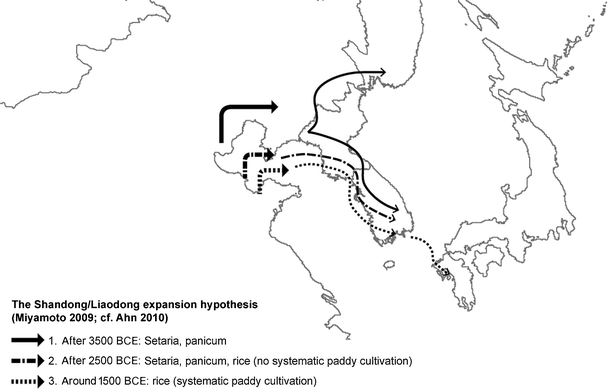
The other by John Whitman provide a synthesis of linguistic and archaeological evidence for the spread of agriculture in Korea and Japan. The image (left) is from Whitman, and summarizes the archaeological picture. He makes a good case that this fits with known linguistic and epigraphic evidence.

Previous papers in this series blogged here (more linguistics) and here (more archaeological).

Friday, 13 January 2012

More contributions on rice, linguistics and genetics

More papers from the Cornell meeting on rice, linguistics and cultural spread continue to come out on-line. This includes my own attempt ("Pathways to Asian Civilizations") to integrate historical linguistics hypotheses, current archaeobotany and recent genetics (including some considerations of issues blogged a few weeks ago).

Perhaps more importantly it includes a updated  assessment of the comparative lingusitics of rice vocabularies by the CNRS linguist Laurent Sagart, who favours an early historical linkage between Sino-Tibetan and Austronesia: for him this relationship is genetic but I wonder whether an early situation on contacts and loans (including millet and rice) makes more sense? An earlier study by Blench collecting rice vocabulary, published in 2008 [available here],  deserves to be considered alongside this paper for its extensive tables across several language families. There is updated overview by Peter Bellwood of his language/farming dispersal hypothesis in its Island Southeast Asian hearth, which includes some important new revisions (such as an early migration eastwards to micronesia and shift in line of newer views of Chinese rice domestication as being later). A rice-driven spread of rice through Indonesia looks less and less plausible, and even though there was some early (late 3rd Millennium BC?) from a few sites it may never have really taken hold: i.e. there was a failed "revolution" in grain culture. In a forthcoming article by Huw Barton on the rice versus sago in Borneo, he makes the case that "Rice appears to be an illogical crop choice in the rainforests of Borneo" by comparison to the higher yielding forest staple Sago (see his yield estimates chart below). Serious and persistence rice agriculture may be much more recent (although I guess before the Malay period when rice was moved from this region to Madagascar).


In relation to Austronesian origins, there is also a paper on rice in Taiwan, which mainly reports some genetic data on local land-races, but also provides the best illustrations yet of some archaeobotanical evidence from the site of Nankuanli (including rice and foxtail millet).

There are also some papers of a more palaeoenvironmental flavour on rice. Quaternary International has a second special issue on "Agricultural activities and rice cultivation in East Asia [Part 2]" coming out. Judging from the editorial, we can expect several pollen  studies from around East and northeast Asia which detect human farming impacts on vegetation, but little that is likely to change views on the origins and spread of rice, nor on archaeobotany. Part 1 was an issue in late 2010, had a few highlights, such as expanded data and discussion of the vegetation, vegetation burning in relation to the early cultivation site of Kuahuqiao (Shu et al), and Li et al's  palynological assessment of vegetation and forests during the Liangzhu period-- worth looking at alongside Fuller & Qin's Environmental Archaeology paper on the environmental context of rice (Dec. 2010). Although it should be noted that Li et al repeat some old mis-identifications from Qianshanyang repeated by non-botanical archaeologists in 1960! Notably "peanut" (introduced via Europeans in the 16th century, see the classic study by Ho 1955) and sesame (probably not older than the Han dynasty: see Fuller 2003)-- the latter certainly is melon (Cucumis melo) which is widely encountered. It pains me to see wrong and unreliable identifications repeated....

More important still is an on-line article by Gary Crawford "Early rice exploitation in the Lower Yangzi: what are we missing?" for a forthcoming issue of The Holocene also on early rice and palaeoenvironment (that I expect to also be an issue that is mainly palynological and sedimentological). It is a thoughtful and provocative paper, partly meant to update Crawford and Shen (1998) and partly meant to be critical of recent work in the Lower Yangtze (including mine), with extended discussions of the issue of immature grains and spikelet base criteria (but without any substantive new suggestions)-- true these criteria are not as straight forward as an either or division, but they still work pretty clearly for characterizing the big trends and transitions. He also summarizes in English a new Chinese proposal (by Gu and Zhao) for morphometric formulae for determining from grain measurements the percentage of rice that was wild or domesticated (although I expect the reliability of such an over-precise formula is dubious). He muddies the definition of "domestication" somewhat by taking a catholic list of "DRT" (domestication-related traits) from the genetics literature-- some of which have little to do with basic crop origins at the beginnings of agriculture, despite their appeal to breeders or the importance in some cultures (like waxiness or white grains). This article includes important critical comments on alleged Pleistocene claims for wild rice, whether from the South China see or Yuchanyan

One of Crawford's main points is to emphasize that we must understand more than rice, that rice "casts a long shadow" on consideration of other resources. (I fully agree, this was the starting point for my original Hemudu critiques [2007, 2008], that 1000s of acorns should not be ignored). He argues consider landscape management for taxa such as oaks and peaches, points I would certainly agree with. He pushes for nut-managers or niche constructors, while characterizing my interpretation as one of "nut-gatherers who became cultivators", which failed to consider other "crops". Perhaps there was management for nuts like acorns (which I suggested in Fuller&Qin 2009), but the problem is that we are hard pressed to see any evidence for this. And if landscapes were managed for nuts (likely to at least some degree) I doubt whether this can be seen as somehow fundamentally different in the Holocene from the kinds of practices that characterized early modern humans in the later Pleistocene (as argued in Fuller, Willcox and Allaby in World Archaeology), since they knew how to manage vegetation through burning and to plant and transplant if desired (as indicated by bottlegourds that must have been cultivated since the Pleistocene beyond Africa) rice cultivation is fundamentally different-- the management for habitats for annual plants rather than landscapes of perennials. A key shift in rice is from perennial ancestors to more productive annuals, a point he touches on as well. And the creation of rice cultivation systems that could select for this and for domestication traits like non-shattering was fundamentally different in outcome and commitment than whatever landscape and tree management that had come before. 

Crawford flirts with the Hayden hypothesis that rice cultivation developed because rice was the first luxury food. While the prestige of risking labour in rice probably is relevant to many cases of secondary adoption, as Huw Barton suggests for rice cultivation in sago-rich Borneo, I am less convinces this is true for the for the sparse early Holocene/terminal Pleistocene Neolithic of Yangtze China. Instead domesticated rice, and its intensified use (from ca. 4500-4000 BC onwards) correlated with material culture evidence from craft specialization and artefactual prestige-goods (see Fuller and Qin 2010). Hayden's speculation (in the recent volume edited by Barker & Jakowski) would be that competitive feasting and prestige battles are there to be found and we just need to keep looking (perhaps in submerged coastal areas which Crawford suggests may hold many secrets). I prefer to focus on the evidence we do have rather than speculate about what is under the sea or alluvium.  Domesticated rice, in the morphological sense, was later than had long been assumed, and created new opportunities for wealth production and demography: it was a game changer, at least in its native Yangtze heartland. Morphological domestication and how rice was cultivated is not an unimportant detail, but central to understanding a major economic and landscape transition which made later Neolithic societies onwards fundamentally different from those that had existed for much longer before in the Early Holocene or Pleistocene... In any case, clearly a paper that deserves reading and thinking about.