Wednesday, 7 March 2012

Dating archaeobotanical treasure troves from Armenia and Peru

The arrival of a new issue of Antiquity is always a welcomed event. The issue that arrived in my mail box this week a particular trove of treasures of an archaeobotanical sort. Not so much for archaeobotanical reports as such (the only such is the study by Willcox and  Strodeur on the details of Jerf el Ahmar), but for tantalizing new information of sites that have exceptional plant assemblages, or that one expects will in the future, like the Han era Pompeii, Sanyanzhuang (blogged below). Two sites, which are well-known for exceptional preservation are the Areni-1 cave complex in Aremenia (Areshian et al in Antiquity), left, and Huaca Prieta mound in coastal peru, below right (Dillehay et al.). 
     Areni made the news a couple of years ago for its early leather footwear, from ca. 3500 BC (Pinhasi et al in PLOSone), but it also has dessicated plant remains of many sorts: emmer and free-threshing wheat and barley, of course, but also lentil, grasspea, grapes, plums, walnuts, almonds and pears. How many of these fruit and nuts represent species that were available wild in the region, were under cultivation or introduced as cultivars still needs to be clarified. The site has produced features indicating on-site wine production, so presumably grapes were cultivated, from at least, from around 4000 BC. 4000 BC is associated with the earliest material reported so far, but the site still has much to yield to excavation, presumably including earlier material. Late samples from the past 2000 years include cotton and textiles.

     Huaca Prieta also boasts exceptional archaeobotanical preservation, and with a long sequence it provides information that suggests the chronology of cultivar introductions in this region. Few plants are likely to be native here and so their introductions point earlier cultivation and domestication elsewhere. This includes Cucurbita sqaush, avocado and lima bean at 7000-5500 BC, and thereafter the appearance of chillis and bottlegourds. Cotton cultivation was established around 4800 BC, and after 4500 BC maize was added to the repertoire. This is some of the best dated and documented early maize in South America, detailed of which were published earlier this year (see previous blog). Peanut, sweet potato and quinoa also come from later levels. Full details are not yet published but some summary can be found in the on-line supplement. This site has also produced coca leaves, indicating the long traditions of chewing this drug plant. Dillehay and colleagues reported the earliest for use of this drug, back to ca. 6000 BC, from elsewhere in northern Peru about a year and half ago, also in Antiquity. Intriguingly this drug plant, plausibly from across the Andes, appeared to already have domestication features at this date.

Monday, 5 March 2012

Han period 'Pompeii' includes farmland

In the latest Antiquity Kidder, Liu and Li report on Sanyanzhuang, a settlement buried by catastrophic Yellow River floods around AD 23. This is a essentially a central Chinese Pompeii but without the burning. So far little of the settlement occupation area has been excavated but it appears that field systems around the site were preserved as well. Some exceptional preservation includes leaf megafossils (leaf casts), in this case of mulberry and elm trees. The report is basically descriptive and notes sampling for pollen. One can hope that in the future systematic flotation and phytolith sampling will be carried out, because a site like this provides an amazing opportunity to ground truth the reliability and biases of the (limited) textual sources on Han agriculture. Despite the fact that written sources refer to "row crop cultivation" (p. 46), as found here.

20,000 yr old huts from Jordan


This report on Kharaneh IV, published in PLoSone  a couple of weeks ago, has a lot of people excited: well-preserved hut features from the early epipalaeolithic of the southern Levant, over 20,000 years old, are a pretty uncommon archaeological find. Most sits of such age provide a bunch of chipped stone, some animal bones and if one is lucky some wood charcoal. Of course, this period has already produced the remarkable Ohalo 2 over in Israel, with amazing plant preservation in burnt down huts of similar age, partial details of which were published in J. Arch Science by Ehud Weiss et al in 2008. One of the problems of Ohalo 2 has been there is so little to compare it with, apart from sites of much later periods. Now there is the opportunity. No plant evidence from Karaneh IV has been reported yet, although colleague here in London are working on it, Sue Colledge on the flotation samples, and a PhD student Monica Nicolaides is working on phytoliths and starch samples. We can expect some important results id due course, although it is unlikely to come close to Ohalo in terms of quantity and preservation in macros, but supplemented by much more systematically collected micros. Other exciting work on the faunal remains is taking place down the hall here, by Lousie Martin, Liz Henton, and Anna Spyrou, which will provide insights into mobility and seasonality.

The archaeology of this site has received plenty of media attention on-line already, and a useful summary at about.com.

Sunday, 4 March 2012

Permafrost anceint DNA

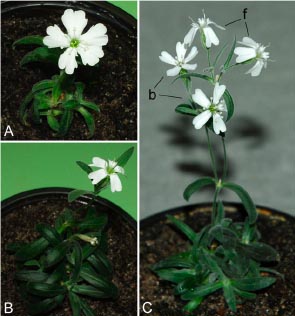
One of the most remarkable, and unusual, pieces of archaeobotany I have seen lately is the report of bringing back to life Pleistocene campion (Silene) flowers, published by Yashina et al in a recent PNAS. Ancient seeds did not themselves germinate, but their genetic material, from immature fruits, was cultured in vitro and then propagated clonally. So the images at right are clones of a plant that was trapped in frost some 31,800 years ago. It is not strictly archaeological, there is no report of a human site there. Direct AMS dates put fruits, apparently from ancient rodent (squirrel) burrows back to over   30,000 years old. 

There are of course periodic reports of extremely old seeds germinating, although in most cases is unlikely that seeds of more than about a century or so, with germinate. See, for example, Barbara Youngman's old review on the germination of old seeds (in Kew Bulletin 1951). "Mummy wheats" are a myth. In general,  longevity may decrease rapidly for many seeds after a decade or so. But natural ice mummy seeds, would appear to be a reality, or at least a source of genetic material that might be propagated by lab methods. As seed banks have learned freezing temperatures can keep seeds longer, slowing down all manner of  enzymatic and decay processes-- part of the rationale for Norway's Svalhard ice burrowing seedbank. 

Will such approaches become more common place? Elephantid phylogenetics have certainly been aided by the ancient DNA from frozen remains of mammoths (see Alan Cooper's 2006 "Year of the Mammoth" in PLOSone): is there is a similar set of phylogenetic surprises in store as more permafrost Pleistocene plants are dug up? Of course permafrost regions are too far north for much in the way of agriculture to be practiced-- taking crops north was a challenge as the archaeobotany of Norway reveals-- so  there is unlikely to be much in the way of agricultural crops.

Early plant cords in rock art?


In the lastest Antiquity project gallery, "fibre technology depicted in archaic art" is a re-interpretion of some rock art from Borneo, as depicting a twisted cord, presumably of some plant fibre, with frayed ends. The image is more than 8000 years old, and also includes human and apparent orangutan figures. Rather than being some sort of symbolic pathway, Judith Cameron, suggests that it represents something material, and she can point towards, admittedly later, evidence for plant cordage from Neolithic burials at Niah Cave. Of course, throughout the Palaeolithic, or at least the later Palaeolithic associated with modern human use of plant fibres, cordage, weaving of baskets must have been quite widespread. In addition to rare finds of actual cordage, such as at Ohalo 2 at >21000 years BP, other plant finds that suggest the use of plant cordage may be seen in the phytolith record: phytoliths of palms and from wild banana (Musa) leaves occur throughout the sequence at Batadomba-Lena rock shelter in Sri Lanka by to 36,000 BP [Perera et al. 2011 People of the Rainforest...]. And as phytolith sampling, and some exceptional examples of preservation, at Catal Hoyuk demonstrate there silica skeletons can provide evidence for Plants as material culture (Ryan 2011 in J. Anthro. Arch.), and so it is not too much of a strecth to think about phytolith, such as those from palms, Musa and many other fibrous monocots, as likely to represent past human gathering for raw materials, perhaps even more so than use as food.


One is reminded of Karen Hardy's impassioned plea for giving more consideration to the importance of string in early evolution on human technology ("String Theory" in Antiqiuty 2008). This reexamining of rock art appears to be step in that direction.  

Wednesday, 22 February 2012

Wild plant use in archaeobotany: a new networking site

A new Groupsite, a kind of private 'facebook' for thematic sharing and networking has been started for the study  the "Ancient Wild Plant Economy", with a group blog and other networking potential. Visit or join at: http://staple.groupsite.com/main/summary.

Something similar, I came across recently in Archaeobotany.net, which provides networking for the archaeobotany of Asia, Australia and Oceania.

Millet ethusiasts and gerbil enthusiats

At first it seems an unlikely place to look for basic information on millets, but it turns out that gerbil enthusiasts also care about millets (e-gerbil). The information is basic, but this website at least includes info on some of the more obscure millets like Browntop millet (Brachiaria ramosa-- they use the Urochloa name); that is more than can be said for wikipedia. They still missed out the Taiwanese oil millet, and some some of the other hypoer-locals, like Digitaria cruciata or the West African fonios. Still, millet enthusiasts are to be encouraged.