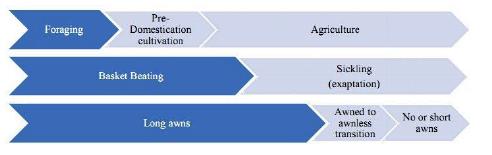
 In a recent paper in Economic Botany, Svizzero, Ray and Chakraborty (2019) ask whether awn reduction is really part of the domestication syndrome of rice or instead a crop improvement trait. It is true that I once listed this as part of the domestication syndrome traits in cereals (Fuller 2007): awn/appendage reduction, but I don't think I really pressed for this to a be central part of domestication. It was only meant to identify a tendency that recurs across most cereals. I would now agree that this post-domestication and varietal improvement trait. That this should be regarded as post-domestication/improvement trait is clear from the fact that it affects only some lineages of rice (most temperate japonica, many indica, but few tropical japonica or circum-aus, and mostly not Oryza glaberrima). Many cultivars have
awns of varying length. The authors usefully illustrate diagrammatically how economy (foraging, pre-domestication cultivation, agriculture), harvesting methods and the evolution of some morphological traits (like the awn) are not synchronous changes. These are part of what makes domestication a protracted and entangled process.
In a recent paper in Economic Botany, Svizzero, Ray and Chakraborty (2019) ask whether awn reduction is really part of the domestication syndrome of rice or instead a crop improvement trait. It is true that I once listed this as part of the domestication syndrome traits in cereals (Fuller 2007): awn/appendage reduction, but I don't think I really pressed for this to a be central part of domestication. It was only meant to identify a tendency that recurs across most cereals. I would now agree that this post-domestication and varietal improvement trait. That this should be regarded as post-domestication/improvement trait is clear from the fact that it affects only some lineages of rice (most temperate japonica, many indica, but few tropical japonica or circum-aus, and mostly not Oryza glaberrima). Many cultivars have
awns of varying length. The authors usefully illustrate diagrammatically how economy (foraging, pre-domestication cultivation, agriculture), harvesting methods and the evolution of some morphological traits (like the awn) are not synchronous changes. These are part of what makes domestication a protracted and entangled process.

Rice domestication was slow, and post-domestication varietal diversification, including the reduction of awns in some varieties, took even longer. And there is much we still don't know about this history-- but a history of varietal and geographical diversification starting to be unravelled in part through genomic history (but that should be a post for another time).


8 comments:
Thank you so much for this post.
Post a Comment